
Abstract
This article examines the U.S. military government in Cuba from 1898 to 1902, with particular emphasis on the role of Leonard Wood in Cuba and the transition from General John Brooke’s limited and often criticized administration to Wood’s more expansive reform program. Drawing on primary and secondary sources, the analysis highlights how U.S. authorities attempted to reconstruct Cuban institutions in education, law, public health, and infrastructure following the devastation of the Cuban War of Independence. While Wood’s administration achieved measurable improvements in schooling, sanitation, and administrative capacity, these reforms were shaped by a broader strategy of political control that restricted suffrage and limited Cuban autonomy. The article argues that the early U.S. occupation of Cuba illustrates the tensions inherent in externally driven state-building efforts, where institutional modernization coexisted with constraints on sovereignty. These dynamics contributed to long-term patterns in Cuba–U.S. relations and offer insight into the broader consequences of interventionist policies in Latin America.
Keywords: Leonard Wood in Cuba; U.S. military government in Cuba; Cuban War of Independence; U.S. intervention in Latin America; state-building; education reform; public health; Cuban legal system; suffrage restrictions; Cuba–U.S. relations
In 1898, Cuba gained independence from Spain after four centuries of colonial rule. However, this did not bring full autonomy. As the United States stepped in to end Spanish occupation, the foundations of Cuba–U.S. relations were laid under a Washington-appointed military government (Lamrani, 2021). Rather than allowing Cuba to govern itself immediately, the United States installed a temporary administration that ruled the island for four years, eventually bringing Leonard Wood in Cuba to lead a transformative military government.
Although these four years significantly shaped Cuba’s development, researchers still devote little attention to analyzing this period.
General Brooke and the Start of U.S. Military Rule
General Robert Brooke, a veteran of the American Civil War, was the first military governor of Cuba, although his tenure was brief. During his time in office, one of his top priorities was expanding education. At the time, Cuba’s educational system was severely underdeveloped. Access to schooling was limited, with only about one-sixth of school-age children attending school in 1899. Even among those enrolled, only a portion attended public institutions, reflecting the fragmented and uneven nature of the island’s educational infrastructure (Fitchen, 1974).
Brooke’s administration quickly drew criticism for both its passivity and its misplaced priorities. Contemporary observers and later historians described his leadership as cautious and lacking direction, failing to translate broader U.S. objectives into effective governance (Hitchman, 1968).
At the same time, Brooke pursued a narrow program of moral regulation, issuing orders to abolish gambling, restrict public entertainment, and even confiscate machetes in the name of public safety (Gillette, 1973). Such measures put Cuba’s agricultural economy at risk, as sugar cane was its most important resource. Critics argued that such interventions reflected a misguided focus on social control rather than the institutional reconstruction the island urgently required.
Leonard Wood in Cuba: Early Foundations of Cuba–U.S. Relations
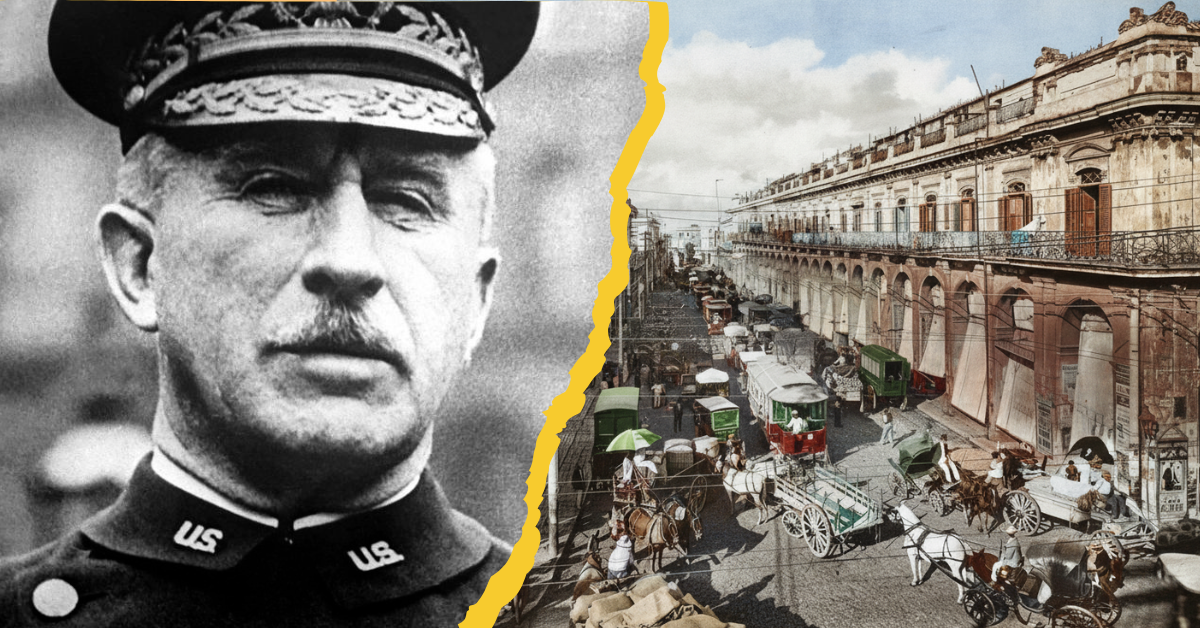
General Leonard Wood was among Brooke’s most outspoken critics. Wood had already gained military prominence for leading the Rough Riders during the Spanish-American War. Under his command, this volunteer cavalry regiment achieved key victories, including the pivotal charge up San Juan Hill. His close friendship with Theodore Roosevelt, who admired Wood’s leadership and military judgment, also proved advantageous (Ferrer, 2021). Roosevelt’s growing national influence further strengthened Wood’s position.
As dissatisfaction with Brooke’s leadership increased, Roosevelt used his connections to advocate for a change. He personally urged Secretary of War Elihu Root to appoint Wood as Brooke’s replacement (Hitchman, 1968). This recommendation carried substantial weight. By December 1899, Wood officially assumed the role of military governor.
Wood approached his new position with marked energy and ambition. He quickly implemented reforms to rebuild the war-torn country, strengthen public health, and address the needs of the Cuban population. Wood himself described the conditions he encountered as “as unfavorable as can be imagined,” marked by widespread disease, starvation, and severe sanitary breakdown, requiring immediate intervention to restore order and basic governance (Wood, 1903).
His leadership style and commitment to structural improvements significantly shaped Cuba–U.S. relations and the broader post-war landscape. His tenure stood in sharp contrast to that of his predecessor.
Education Reform Under Leonard Wood’s Administration
During Leonard Wood’s tenure in Cuba, education reform became one of the administration’s most ambitious goals. The Wood administration enacted sweeping reforms across the island. One of the most significant achievements was the expansion of the public school system, continuing one of Brooke’s earlier priorities.
By the time the United States withdrew from Cuba, the military government had established approximately 3,800 public schools and enrolled hundreds of thousands of students, representing a dramatic expansion of educational access across the island (Wood, 1903). Attendance also became mandatory for children aged 6 to 14 (Ferrer, 2021). Although individual schools retained control over their curricula, the administration created a school board that required teachers to submit monthly and annual reports. Failure to comply could result in delayed salaries (Gillette, 1973). These measures aimed to create a more stable and professional educational system.
Legal and Infrastructure Reforms
Another major accomplishment of Wood’s administration was the attempt to reform the legal system. He authorized the construction of several new courthouses and removed officials he viewed as corrupt or incompetent (Wood, 1903; Gillette, 1973). He sought qualified replacements, but progress remained limited. Because Cuba’s legal system was rooted in a continental civil law tradition rather than in Anglo-American common law, institutions such as trial by jury lacked a well-established foundation and proved difficult to implement effectively (San Miguel Giralt, 2025). Judges often dismissed cases without issuing a decision (Hitchman, 1968).
Law enforcement remained fragmented and institutionally weak during the early occupation. Policing responsibilities were divided among multiple actors, including U.S. troops, remnants of the Cuban Liberation Army, and emerging local forces. Many of these units operated as temporary, “make-shift” arrangements rather than as part of a cohesive system. Even the newly created rural constabulary faced limitations in training, organization, and coordination with civil authorities (Millett, 1972).
Cuba’s infrastructure faced even greater challenges. After multiple wars for independence, the island was left with very few roads or railways connecting rural areas to cities (Hitchman, 1975). This deterioration worsened during General Weyler’s Reconcentration policy, an episode we examine in detail in our article on Cuba’s concentration camps (Tuttle, 2024). Sewer systems were clogged and deteriorating. Homes were overcrowded, and access to clean water was scarce. These conditions contributed to widespread disease and high mortality, particularly in urban areas.
During Wood’s tenure in Cuba, the administration invested substantial resources in street cleaning, sanitation, road construction, and railway expansion. It also funded park restoration and other public improvements (Gillette, 1973). In just four years, the military government achieved remarkable progress in rebuilding the nation. These advances in public health and infrastructure left a lasting impact on Cuba–U.S. relations, even as tensions grew over political control.
Elections, Suffrage Limits, and Rising Tensions
Because the United States did not intend to remain in Cuba indefinitely, the Wood administration established election rules intended to preserve the political path it had created. Concerned that radical factions might gain power after U.S. withdrawal, Wood supported limited suffrage that excluded illiterate citizens (Lane, 1972). He also argued that universal suffrage would discourage foreign investment. Therefore, upcoming elections would be restricted to literate men over age 21 who owned property valued at $250 or more or who had served in the Cuban army during the war against Spain. These requirements excluded roughly two-thirds of the population.
Despite these limits and Wood’s efforts to campaign on behalf of the Union-Democratic Party, the results did not favor him. Most elected officials were individuals he believed would not support U.S. interests or promote Cuban economic growth.
Although the Wood administration raised living standards in many areas, the Cuban desire for self-governance remained stronger. This sentiment persisted for decades, as later Cuban leaders shaped their policies to fit U.S. economic interests. Eventually, the revolution led by Fidel Castro and the establishment of a one-party state emerged from a long history of resentment toward U.S. political influence. Despite the shortcomings of Castro’s government, many Cubans supported it because it symbolized independence and a potentially fairer government than Fulgencia Batista’s regime (Rosendahl, 1997).
Why Cuba–U.S. Relations Still Matter Today
Whether one believes that the United States acted out of self-interest or genuine goodwill, policymakers during the military government viewed Cuba’s economic development as beneficial to the United States. A sustained model of growth would have helped both nations. If the United States had adopted a more cooperative approach rather than relying on coercion, many of the tensions that followed might have been avoided.
More than a century later, Cuba–U.S. relations remain strained by a Cold War–era embargo and by various forms of U.S. intervention that continue to shape daily life on the island. Today, rebuilding ties requires a different strategy. A relationship based on cooperation rather than pressure would honor Cuba’s sovereignty while opening opportunities for economic growth, regional stability, and cultural exchange.
The decisions made during the period of Leonard Wood in Cuba helped define the long-term dynamics between both nations throughout much of the twentieth century.
For the United States, renewed engagement could repair a fractured history and create openings for trade, diplomacy, and security partnerships. For Cubans, it could offer greater economic possibilities and a stronger sense of dignity, as many still endure the burdens of persistent poverty. Ultimately, a more constructive relationship serves the interests of both countries and the hemisphere as a whole.
Further Reading
For readers interested in exploring the historical roots of U.S. intervention in Cuba and its broader implications for Latin America, the following Suru Institute articles provide additional context:
- Concentration Camps in Cuba: Reconcentración and the War for Independence (1895–1898) — A detailed analysis of the humanitarian and infrastructural devastation caused by Spanish reconcentration policies, providing critical context for the conditions inherited by the U.S. military government.
- The Monroe Doctrine in Latin America: Origins, Intervention, and the “Donroe Doctrine” — Examines how the Monroe Doctrine evolved from a defensive policy into a framework for U.S. intervention and hemispheric influence, shaping the logic behind occupations such as Cuba.
- U.S. Interventions in Latin America: Historical Lessons for Venezuela and Hemispheric Security — Connects past intervention strategies to modern cases, highlighting how external involvement can weaken institutions and create long-term dependence rather than stability.
References
Ferrer, A. (2021). Cuba: An American history. Scribner.
Fitchen, E. D. (1974). Primary education in colonial Cuba: Spanish tool for retaining “La isla siempre leal?”. Caribbean Studies, 14(1), 105–120. https://www.jstor.org/stable/25612591
Gillette, H., Jr. (1973). The military occupation of Cuba, 1899–1902: Workshop for American progressivism. American Quarterly, 25(4), 410–425. https://www.jstor.org/stable/2711631
Hitchman, J. H. (1968). The American touch in imperial administration: Leonard Wood in Cuba, 1898-1902. The Americas, 24(4), 394–403. https://doi.org/10.2307/980225
Hitchman, J. H. (1975). Unfinished business: Public works in Cuba, 1898–1902. The Americas, 31(3), 335–359. https://doi.org/10.2307/979878
Lamrani, S. (2021). The origins of the Cuban Revolution of 1959. Études caribéennes, (50). https://doi.org/10.4000/etudescaribeennes.24239
Lane, J. C. (1972). Instrument for empire: The American military government in Cuba, 1899-1902. Science & Society, 36(3), 314–330. http://www.jstor.org/stable/40401653
Millett, A. R. (1972). The rise and fall of the Cuban Rural Guard, 1898–1912. The Americas, 29(2), 191–213. https://doi.org/10.2307/979899
Rosendahl, M. (1997). Inside the revolution: Everyday life in socialist Cuba. Cornell University Press.
San Miguel Giralt, J. (2025). Transplants from different legal families in comparative law: The case of the incorporation of US common law institutions into Cuba for state-building purposes (1898–1902). Amicus Curiae, 7(1), 1–29. http://hdl.handle.net/10138/627936
Tuttle, S. (2024, December 26). Concentration camps in Cuba: Reconcentración and the war for independence (1895–1898). Suru Institute. https://suruinstitute.com/concentration-camps-in-cuba/
Wood, L. (1903). The military government of Cuba. The Annals of the American Academy of Political and Social Science, 21, 1–30. https://www.jstor.org/stable/1009912