

Abstract
This article analyzes the securitization of migration in Chile as a process through which migration flows are constructed as a threat to national security. Using securitization theory, it examines how this discursive shift has enabled the expansion of the armed forces’ roles in border control and internal security. The Chilean case reflects a broader regional trend in Latin America characterized by increasing military involvement in functions traditionally performed by civilian institutions. The article evaluates the institutional implications of this process, including tensions related to jurisdiction, governance, and human rights.
Keywords: Chile border militarization; securitization of migration in Chile; militarization; border control; armed forces; Latin America; national security; governance
Migration flows across Latin America have increased significantly in recent years. The Pan American Health Organization reports that migration in the region has risen by 225 percent since 2021, reflecting a rapidly accelerating rather than stable phenomenon. In response, several governments have begun to frame migration not only as a social or economic issue, but also as a matter of national security.
This shift has contributed to Chile’s border militarization and to the broader expansion of the armed forces’ role in border enforcement and internal security. Under the administration of José Antonio Kast, Chile represents one of the clearest recent examples of this transformation. This article analyzes the securitization of migration in Chile through this theoretical framework, examining how migration is constructed as a threat and what institutional consequences emerge from that process.
The Concept of Securitization
Barry Buzan, Ole Wæver, and Jaap de Wilde from the Copenhagen School introduced the concept of securitization, which they elaborated on in their influential book, Security: A New Framework for Analysis (1998). In this framework, security is not viewed as an objective state but rather as a speech act. This concept is rooted in the work of philosopher John Austin, who proposed that language can perform actions. In this context, security is constructed through discourse.
For these authors, securitization is not an objective state, but rather “the discursive process through which an issue is constructed as an existential threat to a referent object, enabling the use of extraordinary measures to deal with it.” (Buzan, Wæver, & de Wilde, 1998, pp. 23–26).
Securitization of Migration in Chile: Context and Approach
In this context, the securitization of migration in Chile enables policy responses centered on control, surveillance, and the use of extraordinary measures. It also facilitates the involvement of the armed forces in areas that were previously civilian. This trend is evident across several countries in the region, and Chile is among the most recent cases of expanded military involvement.
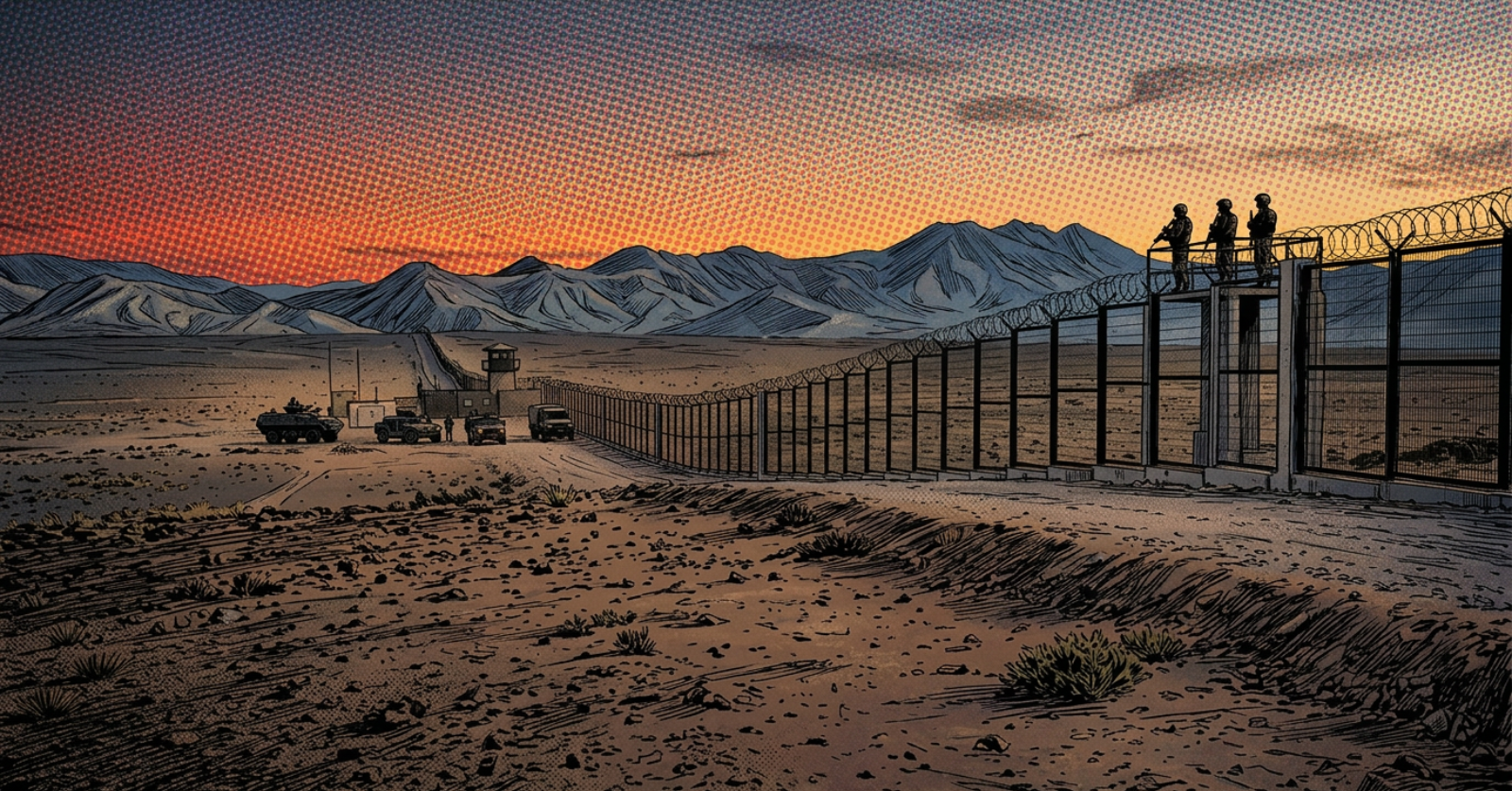
In March 2026, what had been a civilian border space began to take on a more explicitly militarized character. Under the Kast administration, approximately 3,000 military personnel were deployed (Hinojosa, 2026), marking a historic level of military presence in a democratic context. This development raises a central question: to what extent do migration policies respond to genuine security concerns, and to what extent do they redefine migration as a threat that justifies exceptional measures without addressing underlying causes?
Chile’s Border Strategy and the Role of the Armed Forces
In Chile, the sustained increase in migrants entering through the northern border, particularly at Colchane, prompted the Kast administration to implement the Border Shield Plan. Within this strategy, the armed forces play a central role, signaling a shift in both security policy and border governance.
According to official information published by the Chilean government, the plan includes several measures:
- Physical and technological containment systems, including walls or fences up to five meters high, equipped with motion sensors and drone surveillance
- Trenches up to three meters deep
- Electrified perimeter fencing with continuous patrols by the armed forces and Carabineros
- Surveillance towers and thermal radar systems
- Autonomous drones equipped with facial recognition, infrared, and thermal imaging operating continuously (Gobierno de Chile, 2026)
In this context, securitization theory offers valuable insight into Chile’s border militarization. Political and media discourse redefine migration as a threat to national security, thereby legitimizing exceptional measures.
As a result, migration drifts from the realm of ordinary public policy into a crisis management framework. From a securitization perspective, the focus shifts from migration as an issue of integration and rights to an urgent problem requiring control in response to perceived immediate risks to the state. The dominant logic becomes one of containment, including border closures, surveillance, and deportation, rather than regularization, protection, and integration.
Current Challenges of the Border Shield Plan
The strategies implemented in Chile raise several challenges. Military personnel are trained for combat and national defense. When the state assigns them tasks more closely associated with policing, such as identity checks, interviews, the reading of rights, and adherence to due process, it creates an institutional gray area (Dunlap, 1999).
In addition, if a soldier makes an error in performing these functions, questions arise regarding accountability. Police officers are subject to civilian courts, while soldiers fall under military jurisdiction. In this context, a conflict may emerge between legal systems, especially when military personnel interact directly with civilians (Pion-Berlin & Carreras, 2017).
More broadly, Chile’s border militarization reflects a wider regional trend in Latin America: the expansion of military roles into areas traditionally reserved for civilian institutions, which blurs the boundary between internal security and national defense (Dunlap, 1999).
Historical Context of Militarization in the Region
The current military deployment and border strategy in Chile are not isolated developments. They are part of a broader pattern in Latin America of using armed forces in internal security roles. Since the late twentieth century, several countries have relied on military institutions to address nontraditional threats.
The “war on drugs” in Mexico is a clear example of this trend. Beginning in 2006, it led to the long-term deployment of the military in public security roles (Pion-Berlin & Carreras, 2017; Tuttle, 2026). Similarly, military operations in Brazil’s favelas, particularly in Rio de Janeiro, demonstrate how armed forces have been used in urban security contexts (Rekow, 2016).
More recently, El Salvador implemented a “state of exception” in March 2022, suspending constitutional guarantees and significantly expanding the use of security forces, including the military, for internal control. This policy has been widely criticized for its incompatibility with international human rights standards and for the risks associated with the prolonged suspension of fundamental rights (Cárdenas-Gracia, 2024).
These cases illustrate that the securitization of migration is not an isolated phenomenon, but part of a broader regional pattern of increasing militarization. In many instances, this trend has significant implications for human rights.
The Policy Debate
These policies raise important questions about effectiveness and institutional consequences. From the perspective of the Chilean government, they restore territorial control and provide a rapid response to migration flows. At the same time, critics argue that such strategies fail to address the underlying causes of migration and risk normalizing the use of force in civilian contexts, often by actors untrained for such roles.
More broadly, this model raises questions about the appropriate role of the military in democratic societies, the limits of its authority, and the long-term effects on state functions and governance.
Conclusion
Traditional militarism has evolved. In Chile, policies directed at irregular migration are increasingly legitimized through security discourse and presented as temporary measures that risk becoming permanent. This process of securitization reinforces the military’s presence within democratic institutions. In other words, some democratic governments are expanding the use of military forces under conditions where institutional limits are not clearly defined, reshaping the role of the civilian state and the meaning of democratic society.
Further Reading
To explore the expansion of military roles in internal security and related dynamics in Latin America, the following articles may be of interest:
- Security Strategy in Mexico: 18 Years After the War on Drugs — An analysis of the consolidation of militarization as a central element of security policy in Mexico, showing how prolonged military involvement reshapes institutions and creates governance challenges.
- Militarization in Brazil: Public Security and the Role of the Armed Forces — An examination of military deployments in urban environments, particularly in favelas, and their implications for the relationship between internal security and defense.
- Violence in Latin America: The Case of Brazil — An analysis of the relationship between violence, state responses, and security policy, providing broader context for the expansion of military roles in the region.
References
Amnistía Internacional. (2025). Informe al Comité de Derechos Económicos, Sociales y Culturales: Chile. https://www.amnesty.org/es/wp-content/uploads/sites/4/2025/06/AMR2295322025SPANISH.pdf
Austin, J. L. (1962). How to do things with words. Oxford University Press.
Buzan, B., Wæver, O., & de Wilde, J. (1998). Security: A new framework for analysis. Lynne Rienner Publishers.
Cárdenas-Gracia, J. (2024). El régimen de excepción salvadoreño: Una visión extrema del derecho penal del enemigo. Boletín Mexicano de Derecho Comparado, 57(170), 65–97. https://doi.org/10.22201/iij.24484873e.2024.170.19110
Dunlap, C. J. (1999). The police-ization of the military. Journal of Political & Military Sociology, 27(2), 217–232. http://www.jstor.org/stable/45293822
Gobierno de Chile. (2026, March 16). Presidente José Antonio Kast llegó hasta Arica para supervisar implementación del Plan Escudo Fronterizo contra la migración irregular. https://www.gob.cl/noticias/presidente-jose-antonio-kast-llego-hasta-arica-para-supervisar-implementacion-del-plan-escudo-fronterizo-contra-la-migracion-irregular/
Hinojosa, A. (2026, March 18). Chile inicia construcción de muro fronterizo para frenar migración irregular. Notigram. https://notigram.com/internacional/en-el-mundo/chile-inicia-construccion-de-muro-fronterizo-para-frenar-migracion-irregular-20260318-1678515
Instituto Nacional de Derechos Humanos. (2025). Migración: Informe anual 2025. https://www.indh.cl/migracion-informe-anual-2025/
Organización Panamericana de la Salud. (2024). Salud y migración en las Américas: Informe de situación, octubre de 2024. https://www.paho.org/sites/default/files/2024-12/sitrep-healthandmigration-americas-oct-2024.pdf
Plataforma Regional de Coordinación Interagencial para Refugiados y Migrantes de Venezuela. (s. f.). Refugees and migrants from Venezuela. https://www.r4v.info/en/refugeeandmigrants
Pion-Berlin, D., & Carreras, M. (2017). Armed forces, police and crime-fighting in Latin America. Journal of Politics in Latin America, 9(3), 3-26. https://doi.org/10.1177/1866802X1700900301
Rekow, L. (2016). Rio de Janeiro’s Olympic legacy: Public security for whom? Journal of Human Security, 12(1). https://doi.org/10.12924/johs2016.12010074
Tuttle, S. (2026, February 13). Mexico security strategy: 18 years after the war on drugs. Suru Institute. https://suruinstitute.com/mexico-security-strategy/
Unidad de Migración. (2024, December 17). Día Internacional del Migrante: cinco datos sobre América Latina y el Caribe. Banco Interamericano de Desarrollo. https://www.iadb.org/es/blog/migracion/dia-internacional-del-migrante-cinco-datos-sobre-america-latina-y-el-caribe