

Abstract
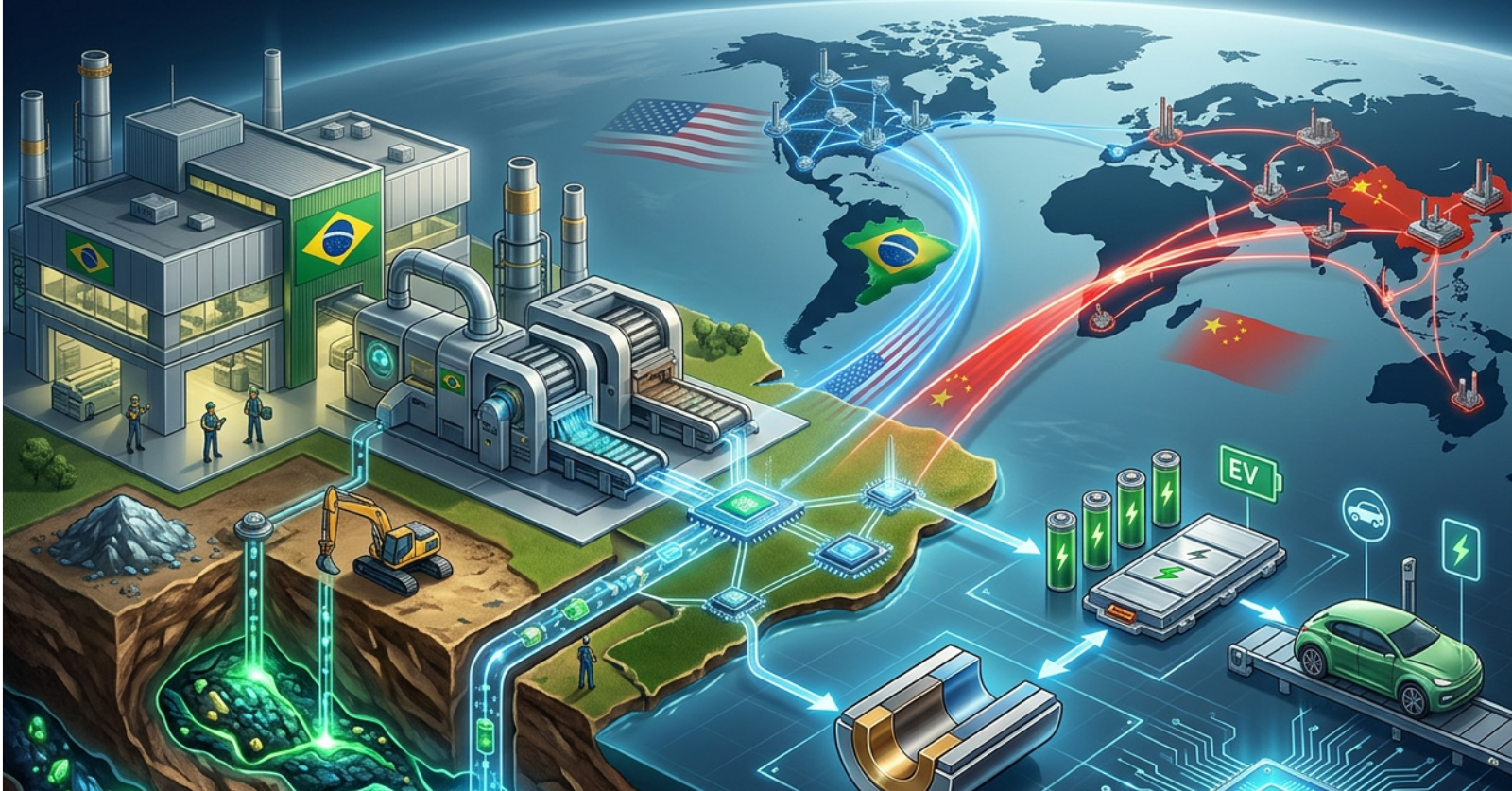
Brazil possesses one of the world’s largest rare earth reserves, yet it still faces major limitations in controlling the higher-value stages of production. Amid growing strategic rivalry between the United States and China, critical minerals have become central to both geopolitical competition and the global energy transition. This article examines the Serra Verde case and the Brazilian debate over industrial sovereignty, local processing, and foreign investment. It also compares the strategies adopted by countries such as China, Australia, Canada, and Chile to develop technological capacity and reduce external dependence. The article argues that the real power of rare earths lies not only in extraction, but in the ability to refine, industrialize, and control the value chains associated with these strategic minerals.
Keywords: Brazil; rare earths; critical minerals; value chain; industrial sovereignty; China; United States; geopolitics; energy transition; mining
Brazil possesses one of the world’s largest rare earth reserves, and growing tensions between the United States and China are increasing the strategic importance of Brazil’s rare earth industry (Sherman, 2025).
China currently controls nearly 90% of the processing capacity for the 17 minerals essential to technologies ranging from electric vehicle batteries to precision-guided missiles (Chia, 2025). At the same time, Washington and Brussels are increasingly aware of the risks associated with dependency, particularly after Europe found itself vulnerable to the Kremlin when natural gas became a geopolitical weapon (Montanini, 2025; Sherman, 2025). As a result, Western governments have spent years attempting to diversify their supply of critical minerals (Associated Press, 2026).
Brazil holds the world’s second-largest rare earth reserves, creating a geopolitical opening that could benefit Latin America (Recabarren Ortiz, 2026). The opportunity depends less on exporting the “gold of the 21st century” as a raw commodity and more on leveraging these resources in exchange for technology and higher-value industrial development.
The energy transition has sharply increased demand for rare earth elements. According to the International Energy Agency’s Global Critical Minerals Outlook 2025 (2025), three-quarters of critical minerals now experience greater price volatility than oil, which not only increases the value of these resources but also strengthens the bargaining power of the countries that possess them.
Serra Verde and Brazil’s Rare Earth Industry
Serra Verde is where that decision is being made today. The company controls Pela Ema, a mine located in Brazil that contains significant volumes of high-tech metals. The project could help counter Beijing’s dominance and allow Brazil to reduce its role as a mere raw-material supplier.
On April 20, Washington backed the sale of Serra Verde to USA Rare Earth with $565 million from the U.S. International Development Finance Corporation (DFC), the American development bank focused on financing strategic projects abroad, along with an additional $1.6 billion in political and financial support (Green Stocks Research, 2026). The deal, paid largely through shares in the acquiring company itself, benefited the private equity funds that previously controlled the mining firm.
Why Critics Oppose the Serra Verde Rare Earth Deal
The deal on the Brazilian side was made possible by the support of then-Governor of Goiás, Ronaldo Caiado. The decision drew political attention because it was one of his final acts before leaving office, and it also raised constitutional concerns. In Brazil, mineral deposits belong to the federal government rather than to the individual states (Mazenotti, 2026). However, the country where the mineral is located was effectively absent from the negotiations.
Critics argue that the terms of the agreement condemn Brazil to repeating a historical pattern: exporting strategic resources without controlling the higher-value stages of production. The full details of the deal have still not been made public. In addition, the operation is moving forward without local refining capacity or a broader public debate over industrial sovereignty (Bambini, 2026).
Brazil still lacks much of the infrastructure needed to add value to what it extracts, particularly at an industrial scale. The problem with that assumption, however, is that the same limitation also applies to the company that acquired the project.
MagBras and Brazil’s Rare Earth Industrialization Strategy
Brazil does not need to start from scratch. The Mineral Technology Center (CETEM), which operates under the federal government, already holds patents for the separation of dysprosium and neodymium. In July 2025, it launched the MagBras Project (CETEM, 2025).
The initiative is an alliance of 38 entities, including WEG, Stellantis, Vale, and Iveco. With an investment of $14.6 million, the project aims to build a complete production chain in Brazil, spanning from mining to magnet manufacturing (FIEMG, 2025).
The problem is that the offtake agreement signed with USA Rare Earth commits MagBras to the four magnetic elements it would need for the next 15 years. Brazil is building the factory while simultaneously signing the contract that could leave it without the materials required to sustain it.
The deal, however, remains open. The transaction is expected to close in the third quarter of 2026 and remains subject to regulatory approval.
China’s Lesson: Why Processing Matters More Than Extraction
It took China decades to master rare earth technology. Although the country discovered the massive Baotou deposit in 1964, it spent another fifty years realizing that real power did not come from extracting more minerals, but from refining, processing, and transforming them into geopolitical instruments.
China demonstrated this in 2010, when a fishing dispute near the Senkaku Islands triggered a diplomatic crisis with Japan. The prices of dysprosium and neodymium, two key rare earth metals, increased tenfold within months, and Tokyo suddenly realized the fragility of a supply chain on which it depended for 90% of its imports. Australia learned the same lesson as well (Chia, 2025).
Australia’s Rare Earth Strategy and the Value Chain
With financial backing from Canberra and Tokyo and a focus on the Mount Weld mine, the mining company Lynas invested heavily in developing its own technological capacity. Since 2023, Australia’s Critical Minerals Strategy has also aimed to move further up the value chain by using public funding to reduce investment risk (Australian Government Department of Industry, Science and Resources [DISR], 2023). The highest-value stages of production are intended to remain within Australian territory. The strategy also includes creating strategic reserves and cooperating with Washington to secure long-term demand.
Today, Lynas accounts for roughly 12% of global rare earth oxide production and has secured strategic contracts with Japan and the United States, particularly with the Pentagon (Seth, 2024).
Chile, Argentina, and Competing Models for Resource Industrialization
If there is still room for renegotiation, Brazil’s closest example is neighboring Chile. For decades, the country exported lithium with little added value through two private companies, one Chilean and one American, which paid royalties without making significant industrial investments. In 2024, however, Chile changed course by shifting its strategy from exporting lithium carbonate and hydroxide to producing battery precursors and advanced components.
Codelco, the world’s largest copper producer and a fully state-owned company, took the lead in the partnership with SQM, Chile’s largest private lithium producer and the current operator of the Atacama Salt Flat, acquiring a controlling 50% plus one share stake.
SQM will retain the remaining stake and continue managing operations due to its technical expertise. Beginning in 2031, however, Codelco will assume control of the board of directors (Codelco & SQM, 2024).
As a result of the agreement, Chile is expected to receive 70% of the profits from new production between 2025 and 2030, a figure that will increase to 85% after 2031 (SQM, 2024). In practice, the contract guarantees 35 years of revenue for the Andean country while allowing the state to move beyond a simple royalty-based model toward greater influence over the industry’s technological development.
The rise of critical minerals is pushing Latin America toward competing development strategies, where outcomes depend largely on who governs and which model they choose to pursue. In contrast to Chile’s approach, Argentina has opted to maximize exports while continuing to sell cheap and buy expensive (de la Vega, 2024). President Javier Milei formalized this strategy in 2024 by implementing the Incentive Regime for Large Investments (RIGI), which offers broad fiscal and regulatory incentives to attract foreign capital without requiring local processing or technology transfer (Albe & Tobin, 2024; Smink, 2024).
The Political Dispute Over Rare Earths in Brazil
For now, the Brazilian government continues to alternate between supportive and contradictory decisions. From Brasília, President Luiz Inácio Lula da Silva and his political base have promoted a sovereigntist discourse. In April, Lula announced in Hannover that Brazil seeks to attract additional stages of mineral processing to its own territory (Vilela, 2026). He also signed a technological cooperation agreement with Germany focused on critical minerals.
In the context of the Serra Verde deal, Brazil’s Minister of Development, Industry, Commerce, and Services, Elias Rosa, argued that critical minerals “must be industrialized, not exported” (Mazenotti, 2026). Not coincidentally, sectors of the governing coalition began pushing for the creation of a state-owned critical minerals company known as TerraBras (Martínez-Vargas, 2026).
However, last month, when Lula had the opportunity to support the initiative, he rejected the proposal that would have given the state direct control over the supply chain, citing opposition from his economic team and pressure from the private sector (Martínez-Vargas, 2026). According to Diógenes Breda, a Brazilian researcher specializing in the political economy of natural resources, the country is currently in a position of strength that it is failing to exploit. In his view, “what is missing are governments with the courage to implement these kinds of measures, because they require a more nationalist approach.”
The Electoral Battle Over Brazil’s Rare Earth Industry
For now, the Serra Verde–USA Rare Earth deal has gained even greater electoral significance, as the agreement is expected to close shortly before the elections.
In Brazil’s domestic political arena, debate over the terms of an agreement of this magnitude with the United States has intensified further because it includes a clause that prevents Brazil from exporting those minerals to China, its largest trading partner, for 15 years. The issue has already become a major point of contention in the electoral debate on both sides (Côrtes, 2026).
Far from settled, Brazil’s Administrative Council for Economic Defense has opened an investigation into possible market concentration. At the same time, the Rede party appealed to the Supreme Federal Court to suspend the sale on the grounds that it violates principles of national sovereignty (Bambini, 2026).
On May 7, when Lula met with his counterpart in the Oval Office, he brought with him the bill approved the previous day by the Chamber of Deputies.
The proposed legislation would grant the executive branch veto power over foreign acquisitions deemed harmful to the country’s geopolitical security. It also includes tax incentives tied to the amount of value added within Brazilian territory. During a press conference, Lula stated that Brazil does not want to remain merely an exporter of raw minerals and that any partnership must include local processing and technology transfer (Deutsche Welle, 2026; Vilela, 2026).
Further Reading
To expand the discussion on rare earths, industrial sovereignty, and geopolitical competition in Latin America, readers may also consult:
- EU–Mercosur Agreement: Strategic Trade and Economic Impact. An analysis of how the agreement between the European Union and Mercosur is reshaping supply chains, strategic trade, and debates over economic dependence in Latin America.
- The Argentine Pipeline and Regional Energy Geopolitics. An exploration of how Argentina seeks to transform its energy resources into a tool for development and regional influence amid international disputes over infrastructure and exports.
- Mining in Mexico: A Socio-Political Analysis of Extractivism. A broader examination of the political and economic challenges surrounding mining in Latin America, including debates over foreign investment, state control, industrialization, and technological dependence.
References
Albe, I., & Tobin, W. (2024, December 5). What to know about Argentina’s new investment promotion regime. Atlantic Council. https://www.atlanticcouncil.org/blogs/new-atlanticist/what-to-know-about-argentinas-new-investment-promotion-regime/
Associated Press. (2025, August 22). China reforça controle sobre mineração e processamento de terras raras. CNN Brasil. https://www.cnnbrasil.com.br/economia/macroeconomia/china-reforca-controle-sobre-mineracao-e-processamento-de-terras-raras/
Australian Government Department of Industry, Science and Resources. (2023, June). Critical minerals strategy 2023–2030. Commonwealth of Australia. https://www.industry.gov.au/publications/critical-minerals-strategy-2023-2030
Bambini, A. (2026, April 23). STF proíbe compra de terras por empresas estrangeiras. CNN Brasil. https://www.cnnbrasil.com.br/agro/stf-confirma-limites-de-compras-de-terras-por-estrangeiros/
Centro de Tecnologia Mineral (CETEM). (2025, August 25). MagBras – Demonstrador industrial do ciclo completo de produção brasileira de ímãs permanentes de terras raras. Governo Federal do Brasil. https://www.gov.br/cetem/pt-br/acesso-a-informacao/acoes-e-programas/projetos-financiados-por-agencias-e-ou-recursos-publicos/em-curso/magbras-2013-demonstrador-industrial-do-ciclo-completo-de-producao-brasileira-de-imas-permanentes-de-terras-raras-1
Chia, O. (2025, October 17). Como a China conseguiu encontrar “ponto fraco” de Trump com restrição às terras raras. BBC News Brasil. https://www.bbc.com/portuguese/articles/cly2d9701z8o
Codelco & SQM. (2024, May). Signing of partnership agreement: Codelco–SQM [PDF]. https://www.codelco.com/prontus_codelco/site/docs/20160401/20160401130745/310524_firma_acuerdo_codelco_sqm_eng_docx__ok_.pdf
Côrtes, P. (2026, April 21). Análise: Brasil busca protagonismo em terras raras. CNN Brasil. https://www.cnnbrasil.com.br/blogs/pedro-cortes/infra/analise-brasil-busca-protagonismo-em-terras-raras/
de la Vega, C. (2024, June 4). RIGI: La entrega incondicional de los recursos naturales. Agencia TSS. https://www.agenciatss.com.ar/rigi-la-entrega-incondicional-de-los-recursos-naturales/
Deutsche Welle. (2026, May 7). Cámara baja de Brasil aprueba ley para controlar tierras raras. DW Español. https://amp.dw.com/es/c%C3%A1mara-baja-de-brasil-aprueba-ley-que-ampl%C3%ADa-control-del-estado-sobre-tierras-raras/a-77072658
FIEMG. (2025, July 15). Brasil dá partida ao projeto MagBras para fortalecer autonomia tecnológica na produção de ímãs de terras raras. https://www.fiemg.com.br/fiemg/noticias/kick-off-reune-28-empresas-e-marca-o-inicio-de-uma-iniciativa-nacional-com-investimento-de-r-73-milhoes-para-consolidar-a-cadeia-produtiva-de-imas-permanentes/
Green Stocks Research. (2026, April 20). USA Rare Earth acquires Brazilian rare earth miner Serra Verde for $2.8 billion. https://greenstocksresearch.com/usar-acquires-serra-verde/
International Energy Agency. (2025). Global critical minerals outlook 2025. IEA. https://www.iea.org/reports/global-critical-minerals-outlook-2025
Martínez-Vargas, I. (2026, April 23). Governo Lula descarta apoio à criação da TerraBras, estatal de minerais críticos. Exame. https://exame.com/brasil/governo-lula-descarta-apoio-a-criacao-da-terrabras-estatal-de-minerais-criticos/
Mazenotti, P. (2026, April 24). Terras raras: governo articula Política Nacional de Minerais Críticos: “Não queremos ser um exportador de matéria-prima”, diz ministro. Rádio Nacional. https://agenciabrasil.ebc.com.br/radioagencia-nacional/economia/audio/2026-04/terras-raras-governo-articula-politica-nacional-de-minerais-criticos
Montanini, M. (2025, January 4). Como o bloqueio ucraniano ao gás russo pressiona a Europa. Nexo Jornal. https://www.nexojornal.com.br/expresso/2025/01/04/guerra-ucrania-russia-bloqueio-gas-europa
Recabarren Ortiz, C. (2026, March 22). Brasil busca protagonismo global con sus tierras raras y riqueza tecnológica. Redimin. https://www.redimin.cl/brasil-busca-protagonismo-global-con-sus-tierras-raras-y-riqueza-tecnologica
Seth, N. (2024, August 15). How to diversify mineral supply chains: A Japanese agency has lessons for all. New Security Beat. https://www.newsecuritybeat.org/2024/08/how-to-diversify-mineral-supply-chains-a-japanese-agency-has-lessons-for-all/
Sherman, N. (2025, October 10). Trump ameaça tarifa de 100% sobre a China em retaliação a decisão do país asiático sobre terras raras. BBC News Brasil. https://www.bbc.com/portuguese/articles/c2dn96700l8o
Smink, V. (2024, June 13). 4 grandes cambios que contempla la Ley Bases, la primera legislación que Milei logró aprobar en el Congreso de Argentina (y el regreso del impuesto a las ganancias). BBC News Mundo. https://www.bbc.com/mundo/articles/clmmv7m4pvko
SQM. (2024, May 31). Codelco and SQM sign partnership agreement making Chile a leader in the global lithium market. https://sqm.com/en/noticia/codelco-y-sqm-firman-acuerdo-para-asociacion-que-da-a-chile-liderazgo-en-el-mercado-mundial-de-litio/
Vilela, P. R. (2026, April 20). Brasil e Alemanha firmam acordo sobre minerais críticos e terras raras: Parceria prevê pesquisa, inovação industrial e financiamento. Agência Brasil. https://agenciabrasil.ebc.com.br/economia/noticia/2026-04/brasil-e-alemanha-firmam-acordo-sobre-minerais-criticos-e-terras-raras