

Abstract
This article examines how drug trafficking routes in Latin America have evolved from hierarchical cartel structures into decentralized, transnational networks. It focuses on the roles of Colombia, Ecuador, and Mexico to show how production, logistics, and distribution have become integrated within an increasingly coordinated global system. Drawing on recent reports and investigative research, the article argues that state responses, often centered on territorial control and militarized strategies, have failed to adapt to the logic of these networks. It also analyzes the role of external demand and the global financial system in sustaining these flows. Overall, the article proposes that contemporary drug trafficking should be understood not as a set of isolated routes, but as a coordinated transnational architecture with high local social costs.
Keywords: drug trafficking routes in Latin America; drug trafficking; cocaine trafficking; transnational organized crime; criminal networks; Colombia; Ecuador; Mexico; militarization; regional security
Introduction: From Cartels to Transnational Networks
In November of last year, U.S. military forces deployed the USS Gerald R. Ford to the coasts of Latin America as part of Operation Southern Lance. The aircraft carrier, the largest in the world, spans roughly three football fields. Accompanied by guided missile destroyers, the deployment followed initial strikes against suspected drug trafficking vessels in September and October 2025, according to U.S. Southern Command. The stated objective was to intercept maritime drug trafficking flows in the Caribbean and Latin America. On March 7 of this year, 17 countries from across the Americas, excluding Mexico, Brazil, and Colombia, met at Trump National Doral in Miami to form the “Shield of the Americas,” a U.S.-led coalition against organized crime.
As governments escalate military responses, drug trafficking networks continue to scale their logistics. Since the 1990s, organizations once portrayed as hierarchical cartels led by a single kingpin have evolved into distributed networks. These networks operate with the efficiency of multinational firms and cross borders more easily than states attempting to contain them, according to reports from the United Nations and the U.S. Drug Enforcement Administration.
This article analyzes how drug trafficking routes in Latin America function today and how they have evolved from hierarchical structures into transnational networks.
The Evolution of Drug Trafficking: From Hierarchical Structures to Networks
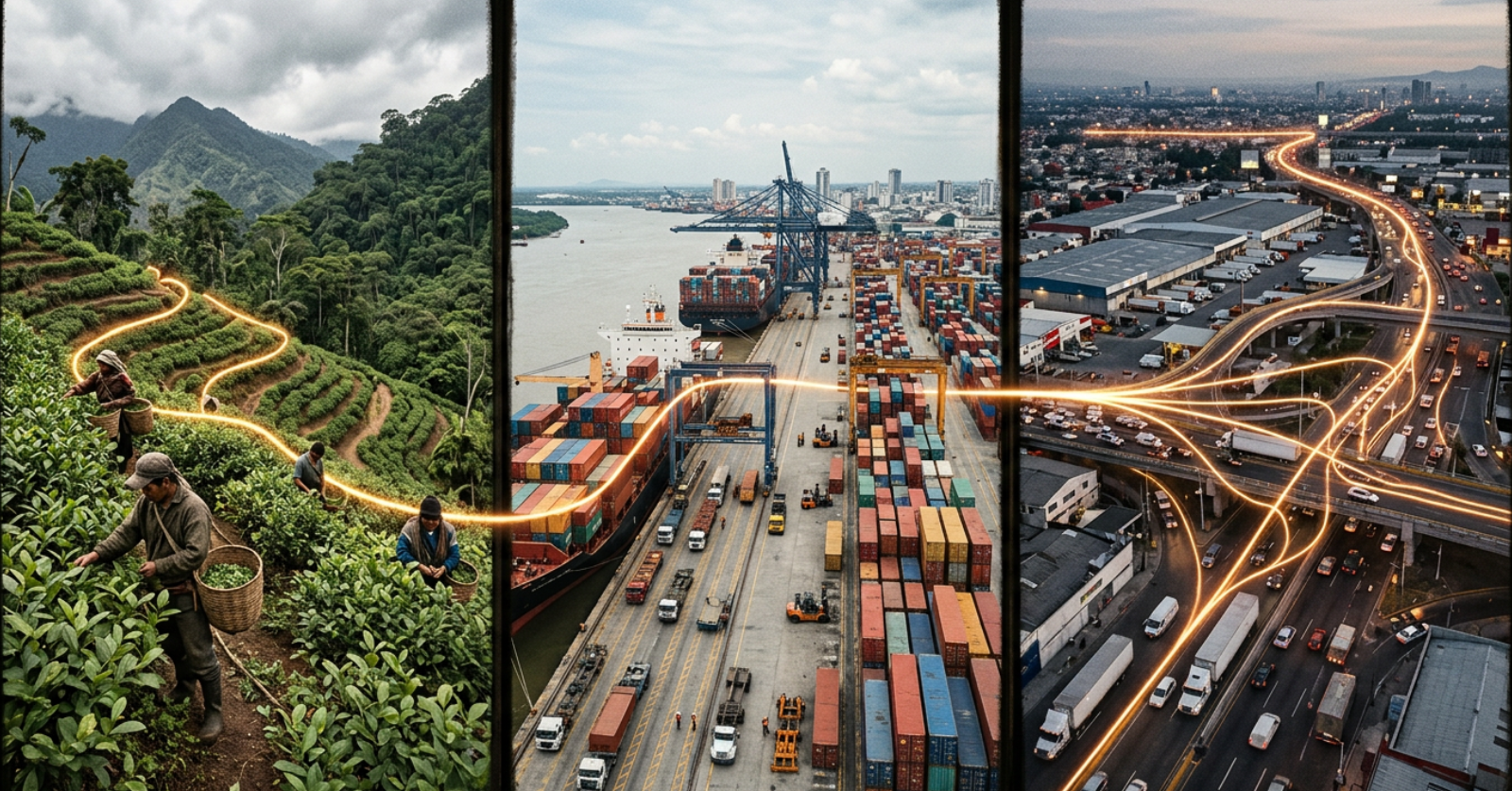
What was once a constellation of local organizations now operates as an integrated structure, connecting territories, drug-trafficking routes in Latin America, and global markets with increasing precision and profitability. The axis formed by Colombia, Ecuador, and Mexico is where this system takes shape, with each country playing a distinct role. This transformation has reshaped not only organizational structures but also the relationship between criminal groups and the territories in which they operate.
Colombia: Cocaine Production in the Drug Trafficking Supply Chain
Throughout the 1990s, Colombia consolidated its position as the world’s largest producer of cocaine, surpassing Peru and Bolivia. By 2023, the country had 253,000 hectares under coca cultivation, an area roughly equivalent to the size of Luxembourg (United Nations Office on Drugs and Crime [UNODC], 2024). Colombia’s proportion accounted for 67.3% of the 376,000 hectares cultivated globally that year, according to the World Drug Report 2025 (UNODC, 2025).
Production is typically concentrated in peripheral regions with limited state presence, where armed groups organize the entire process, from cultivation to the transformation of coca leaf into cocaine. In Catatumbo, a border region with Venezuela and one of the country’s main coca-producing areas, the National Liberation Army (ELN) controls this flow. It recruits farmers on both sides of the border (InSight Crime, 2025). The group exploits regional poverty to secure labor, particularly among vulnerable Venezuelan migrants. Rules are strict, and boundaries are often invisible.
While the drug economy is highly profitable, its benefits are unevenly distributed. A kilogram of cocaine that leaves the farm at around $1,500 can reach $25,000 on international markets (McDermott, 2025). Farmers, however, occupy the weakest position in the chain (UNODC, 2025). Their incomes are unstable and subject to the gramaje, a tax imposed by criminal groups that charges a fixed fee per gram of coca paste produced in territories under their control.
After harvest, the ELN operates its own crystallization laboratories. Catatumbo is often described as the “ATM” of Colombian armed groups (McDermott, 2025). Its eleven municipalities contain approximately 55,000 hectares of coca, with the potential to produce up to 400 metric tons of cocaine annually and generate around $600 million per year at the production stage, according to InSight Crime.
Ecuador: A Logistics Hub in Drug Trafficking Networks
While Venezuela serves as a transit corridor toward the Caribbean and Brazil, and from there to the Atlantic en route to Europe and other markets, Ecuador has emerged as a central logistical hub in the global drug trade. Following the death of Pablo Escobar in 1993 and the collapse of the Cali cartel in 1995, the cocaine trade fragmented into smaller and more decentralized networks. This shift opened the door for the ’Ndrangheta, an Italian mafia group, to begin operating directly with producers at the source, in a process often described as “upstream displacement” (Pardo, 2024).
Since the late 1990s, Balkan criminal groups have reinforced this model by establishing their own supply networks to Europe, consolidating their position between 2008 and 2015 as dominant actors in the continental market (González Tomadin, 2024).
Paradoxically, the rise of Ecuadorian ports such as Guayaquil as key nodes in cocaine trafficking was partly driven by state enforcement efforts in Colombia (Bargent, 2019). Plan Colombia, launched in 2000 with U.S. funding and implemented through aerial fumigation and military operations, displaced coca cultivation and trafficking routes southward toward a border region where the Ecuadorian state had limited presence. These routes proved more resilient, operating amid weaker institutional oversight, higher corruption levels, and limited port controls.
With the involvement of Balkan, Italian, and Albanian networks, logistics became increasingly strategic (McDermott et al., 2021), penetrating local elites and port systems (UNODC, 2025). Today, cocaine is often concealed within shipping containers belonging to shell companies exporting agricultural goods from Guayaquil. Bananas, due to their perishable nature, provide an ideal cover that allows shipments to move quickly through customs. Approximately 90% of global trade is conducted through maritime containers. However, less than 2% are inspected, according to UNODC (2024) and the World Customs Organization.
Another widely used method is the “rip-on/rip-off” technique (Europol, 2023). Criminal groups select a legitimate container, break the original seal, insert drug packages, and replace it with a cloned seal bearing the same identification number. The container’s owner is often unaware that it has been used to transport illicit goods.
Mexico: Distribution and Control of Drug Trafficking to the United States
While Colombia and Ecuador structure trafficking routes toward Europe and Asia, Mexico occupies a distinct role as the primary supplier of illicit drugs to the United States (Infobae, 2023a). Unlike South American countries, it is not a major producer of cocaine. However, it has become the central hub for its distribution. It was this role in trafficking, rather than cultivation, that transformed former agricultural actors into leaders of transnational criminal conglomerates. This shift consolidated in the 1990s, when Mexican groups began receiving up to 50% of Colombian shipments as payment for transportation, moving from intermediaries to owners of the product.
Today, organizations such as the Sinaloa Cartel and the Jalisco New Generation Cartel (CJNG) exert control across the entire supply chain, from overseeing production in Colombia and Peru to retail distribution, effectively setting prices at both ends of the market (Infobae, 2023b). At the same time, Mexico has also become a major center for the production of synthetic drugs. Cartels import chemical precursors, primarily from China, to manufacture fentanyl and methamphetamine at scale in domestic laboratories, supplying primarily the U.S. market.
Across parts of Latin America, there is a persistent belief that “the law of the cartels is stronger than that of the state.” In many contexts, this is not merely rhetorical. In Mexico, organizations such as Sinaloa and CJNG provide food, build roads, and fund local infrastructure in marginalized areas, thereby generating social legitimacy in places where the state is weak, absent, or compromised. At the same time, they impose their own systems of order, banning certain crimes, mediating disputes, and enforcing rules through parallel systems of justice that are often both rudimentary and lethal. Informing on these groups frequently carries fatal consequences.
Demand, Financing, and the Sustainability of the System
Within drug trafficking routes in Latin America, there is a critical dimension that the image of a U.S. aircraft carrier patrolling the Caribbean tends to obscure. Without U.S. demand for cocaine and fentanyl (UNODC, 2025) and without European capital that launders and finances these networks (McDermott et al., 2021), there would be no supply chain to intercept. What policymakers in Washington and Brussels describe as a “regional security problem” is, to a significant extent, a market sustained by demand.
Historically, anti-drug strategies have disproportionately targeted the weakest links in the chain, such as small-scale coca farmers and low-level distributors. Meanwhile, the global financial system has largely avoided comparable scrutiny (BBC News Mundo, 2020). The FinCEN Files, leaked in 2020, revealed that major banks, including HSBC, JPMorgan, and Deutsche Bank, processed transactions linked to organized crime for years. Financial penalties followed, but criminal prosecutions were rare.
Conclusion: A Global System with Local Costs
Rather than a mosaic of isolated routes, drug trafficking routes in Latin America now operate as an integrated global system with functionally differentiated roles. Colombia produces most of the world’s cocaine, Ecuador exports it through ports such as Guayaquil, and Mexico refines, distributes, and industrializes it within a system shaped by successive enforcement efforts that have displaced the problem without resolving it.
State responses continue to rely on an outdated territorial logic. While governments deploy naval assets and military force, criminal networks optimize flows, diversify risk, and outsource key functions to local actors. They operate with the flexibility of multinational firms, but without transparency or accountability.
This system is sustained from both ends. In the global South, farmers face limited alternatives, and states often lack the capacity or integrity to provide them. In the global North and parts of Europe, demand remains steady while financial systems process illicit profits with penalties but few consequences. Addressing this system through interdiction alone is, at best, inefficient. For some actors, it may not represent failure, but rather a stable equilibrium.
Further Reading
For additional analysis on security policy, militarization, and regional violence dynamics, readers may also be interested in:
- Mexico’s Security Strategy: 18 Years of the War on Drugs — A long-term analysis of Mexico’s security strategy and its limited effectiveness against increasingly complex criminal networks. The article complements this discussion by showing how state responses have often relied on militarization without altering the underlying dynamics of drug trafficking networks.
- Militarization and Violence in Mexico — An examination of how the growing role of the armed forces in public security has reshaped institutional balance and patterns of violence. This piece helps explain why strategies centered on territorial control struggle to address decentralized criminal organizations.
- Violence in Latin America: Brazil’s Crisis and Regional Dynamics — A comparative perspective on violence and state responses across the region. The analysis situates Mexico’s trajectory within broader Latin American trends, highlighting how governance and security challenges extend beyond national borders.
References
BBC News Mundo. (2020, September 22). FinCEN Files: 4 grandes bancos utilizados por oligarcas, corruptos y criminales para mover dinero sucio. https://www.bbc.com/mundo/noticias-internacional-54240611
Bargent, J. (2019, October 30). Ecuador: A cocaine superhighway to the US and Europe. InSight Crime. https://insightcrime.org/investigations/ecuador-a-cocaine-superhighway-to-the-us-and-europe/
Europol. (2023). Criminal networks in EU ports: Risks and challenges for law enforcement. https://www.europol.europa.eu/cms/sites/default/files/documents/Europol_Joint-report_Criminal%20networks%20in%20EU%20ports_Public_version.pdf
González Tomadin, F. (2024, May 7). Cómo los gánsteres de los Balcanes se convirtieron en los principales proveedores de cocaína de Europa. Infobae. https://www.infobae.com/america/mundo/2024/05/07/como-los-gansteres-de-los-balcanes-se-convirtieron-en-los-principales-proveedores-de-cocaina-de-europa/
Infobae. (2023a, January 16). Cómo fue que los cárteles mexicanos pasaron a ser los amos de la cocaína en Colombia. https://www.infobae.com/america/mexico/2023/01/16/como-fue-que-los-carteles-mexicanos-pasaron-a-ser-los-amos-de-la-cocaina-en-colombia/
Infobae. (2023b, March 16). Cárteles mexicanos están apoderándose del mercado colombiano de la cocaína, advirtió la ONU. https://www.infobae.com/mexico/2023/03/16/carteles-mexicanos-estan-apoderandose-del-mercado-colombiano-de-la-cocaina-advirtio-la-onu/
InSight Crime. (2025, December 8). Cocaine corridor: Drugs drive ELN’s Venezuela expansion. https://insightcrime.org/investigations/cocaine-corridor-drugs-drive-eln-venezuela-expansion/
McDermott, J. (2025, December 8). Guerras fronterizas: El ELN y la toma del Catatumbo. InSight Crime. https://insightcrime.org/es/investigaciones/guerras-fronterizas-eln-toma-catatumbo/
McDermott, J., Bargent, J., den Held, D., & Ramírez, M. F. (2021, February). El itinerario de la cocaína hacia Europa. InSight Crime & Global Initiative Against Transnational Organized Crime. https://insightcrime.org/wp-content/uploads/2021/09/El-itinerario-de-la-cocaina-hacia-Europa-Reporte-2021-GI-InSight-Crime.pdf
Pardo, J. (2024, November 11). Estas son las dos mafias italianas que se fortalecen en Colombia: Se quieren apoderar de la coca y de las rutas del narcotráfico. Infobae. https://www.infobae.com/colombia/2024/11/11/estas-son-las-dos-mafias-italianas-que-se-fortalecen-en-colombia-se-quieren-apoderar-de-la-coca-y-de-las-rutas-del-narcotrafico/
United Nations Office on Drugs and Crime (UNODC). (2024, November 19). Contenedores íntegros para combatir el tráfico ilícito de mercancías. https://www.unodc.org/lpomex/noticias/noviembre-2024/contenedores-integros-para-combatir-el-trafico-ilicito-de-mercancias.html
United Nations Office on Drugs and Crime (UNODC). (2024). Monitoring of territories with presence of coca crops 2023 (SIMCI report). https://www.unodc.org/documents/crop-monitoring/Colombia/Colombia_survey_report_EN_2023.pdf
United Nations Office on Drugs and Crime (UNODC). (2025). World drug report 2025. https://www.unodc.org/unodc/data-and-analysis/world-drug-report-2025.html