
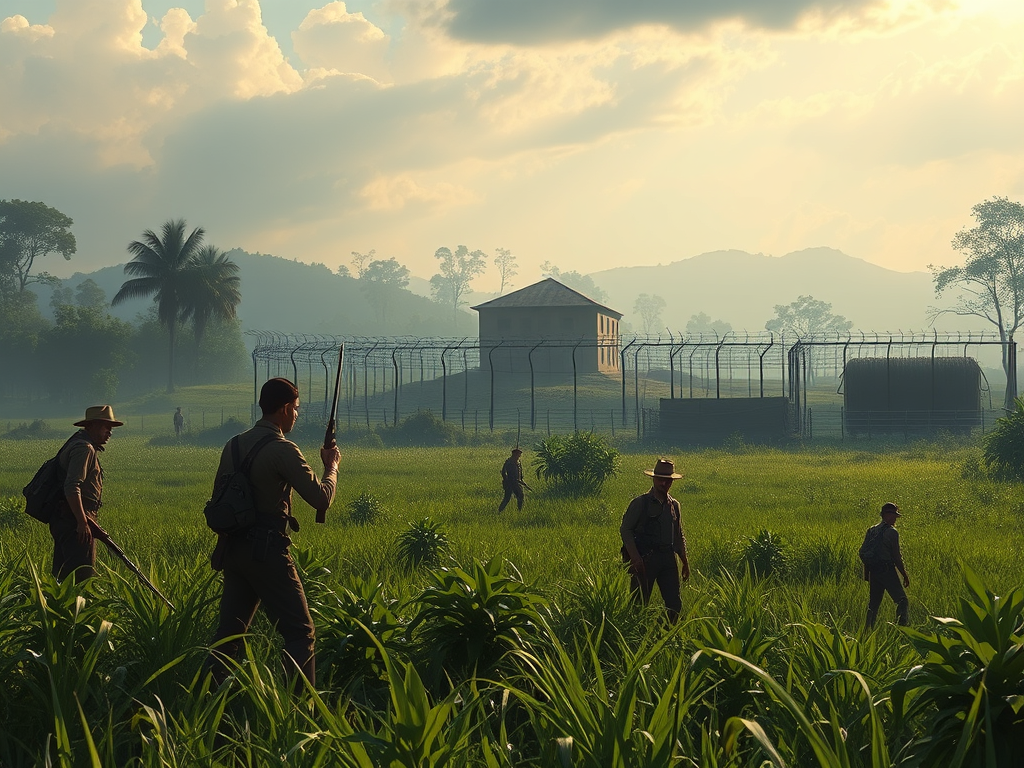
Concentration camps in Cuba emerged in the late nineteenth century when Spanish colonial authorities implemented a policy of civilian reconcentración as part of a broader counterinsurgency campaign against independence fighters. Designed to separate rural populations from guerrilla forces, the policy resulted in mass displacement, widespread famine, and extraordinarily high civilian mortality (Ferrer, 2021).
Arsenio Martínez Campos and the Moral Dilemma of Empire
It was 1895, and then-Cuban governor-general Arsenio Martínez Campos found himself at a moral impasse (Pitzer, 2017; Ferrer, 1999). On one hand, he expressed a degree of admiration for the Cuban revolutionaries fighting for their independence. He deemed them honorable adversaries due to their humane treatment of Spanish prisoners of war. Rather than execute or torture these soldiers, the Cuban rebels returned unharmed in an act of clemency.
While Martínez Campos respected their mercy, he also believed the most effective path to quashing the Cuban resistance would be to respond with calculated acts of cruelty. As the Spanish had little control over rural areas, the countryside became a sanctuary for guerilla fighters to garner support, strategize, and thrive. In these remote locations, sympathetic campesinos offered food and lodging, sometimes even joining the movement. Likewise, hiding among the rural populations allowed these fighters to evade Spanish detection.
Enter Valeriano Weyler: The Architect of “Reconcentration”
Martínez Campos recognized the crippling effect destroying these resources would have on the rebel movement. Therefore, he wrote to the Spanish prime minister to relay his ideas, simultaneously requesting excusal from his post as he did not want to be the one to inflict such atrocities. Honoring his request, Spain sent Captian General Valeriano Weyler to take over the reins of Cuba along with reinforcements (Cabrera Geserick, 2021–2022), placing all hope that he would retain the colony by any means necessary.
Upon reaching Cuba, Weyler immediately got to work forcing campesinos out of the rural areas and into urban reconcentration camps, fortified by the fairly recent inventions of barbed wire and machine guns (Forth & Kreienbaum, 2016). Spanish troops then stormed the countryside, destroying crops, livestock, and housing (Tone, 2006). Following in the footsteps of General William Sherman’s “March to the Sea” approach during the American Civil War, Weyler’s tactic separated rebel fighters from civilians who aided them and the additional resources they offered (Tooley, 2007).
Weyler failed to provide provisions for the reconcentration camps, creating a dismal living situation for the interred. Estimates of civilian deaths range widely. John L. Tone’s (2006) provincial reconstruction suggests at least 170,000 civilian deaths, which amounts to roughly ten percent of the island’s population. Other figures range significantly higher (Stucki, 2018).
International Outrage and the Fall of Spanish Cuba
Though Weyler’s campaign temporarily stymied the guerilla tactics rebels relied on, it generated mounting political and diplomatic backlash, ending in Weyler’s recall by the Liberal government of Práxedes Sagasta in late 1897 and, ultimately, Spain’s loss of the colony (Offner, 1998). First, it served to unite Cubans in the quest for independence against what they could then agree to be a cruel and tyrannical ruler. It also divided Spanish politicians, as some, particularly the Liberals, saw this approach as a step too far. Finally, politicians and the press in the United States widely publicized their condemnation of concentration camps in Cuba, which won some popular support for the U.S. officials getting involved in Cuba’s struggle against Spain (Stucki, 2018).
Once Spain was finally out of the picture, Cuba did not have complete autonomy. Five years after Cuba gained its independence, the U.S. Congress intervened in its constitutional convention, demanding that the island include the Platt Amendment in its constitution (Ferrer, 2021), effectively making Cuba a protectorate of the United States. Though the Platt Amendment’s supporters argued it protected Cuba’s stability, it also denied Cuba the autonomy its revolutionaries truly sought, setting the stage for decades of tension between the two nations.
Conclusion: Lessons in Power and Collaboration
This pattern of coercive paternalism would reappear repeatedly in hemispheric politics, from U.S. occupations in the early twentieth century to Cold War proxy conflicts.
The story of Cuba’s reconcentration camps offers more than a grim historical footnote. It illustrates a recurring pattern in the Western Hemisphere. When stronger nations try to impose order on weaker ones, violence and instability often follow. From colonial Cuba to the Cold War to present-day economic interventions, the lesson remains the same. Sustainable peace is built through partnership, not paternalism.
If the nineteenth century was defined by conquest, the twenty-first must be defined by collaboration, which means nations must be willing to solve problems with one another, not for one another.
Further Reading
For readers interested in how coercive state strategies and imperial governance have shaped political development across the Americas, the following Suru analyses expand on themes raised in this article:
- Leonard Wood in Cuba: U.S. Military Government and the Limits of Intervention — An examination of the U.S. occupation government that followed Spain’s defeat in 1898. This piece explores how military administration, public health reform, and constitutional engineering laid the groundwork for the Platt Amendment era and continued constraints on Cuban sovereignty.
- Mass Incarceration in Democracies: The United States and Argentina — A comparative analysis of punitive expansion within formally democratic systems. The article complements the discussion of reconcentración by examining how modern states justify large-scale confinement in the name of order, security, and institutional stability.
- Brazil’s Sociopolitical Cataclysm: The Dangers of Unchecked Military Institutions — A study of how military actors can become central political arbiters in times of crisis. This analysis situates the Cuban case within broader hemispheric debates about civil-military relations and the long-term consequences of securitized governance.
References
Cabrera Geserick, M. (2021–2022). Cultural imperialism in Latin American newspapers: Costa Rican and Mexican press on the Cuban reconcentración (1896–1898) (pp. 63–81). In Sargasso: A Journal of Literature, Language, & Culture, 2021–22 (I & II) Camps, (In)justice, & Solidarity. https://d1wqtxts1xzle7.cloudfront.net/118785741/Sargasso_Camps_2024_color_1_-libre.pdf?1728531439 (Original work published 2021–22)
Ferrer, A. (1999). Insurgent Cuba: Race, nation, and revolution, 1868-1898. University of North Carolina Press.
Ferrer, A. (2021). Cuba: An American history. Scribner.
Forth, A., & Kreienbaum, J. (2016). A shared malady: concentration camps in the British, Spanish, American and German Empires. Journal of Modern European History, 14(2), 245-267. https://doi.org/10.17104/1611-8944-2016-2-245
Offner, J. (1998). Why Did the United States Fight Spain in 1898? OAH Magazine of History, 12(3), 19–23. http://www.jstor.org/stable/25163215
Pitzer, A. (2017, November 2). Concentration camps existed long before Auschwitz: From Cuba to South Africa, the advent of barbed wire and automatic weapons allowed the few to imprison the many. Smithsonian Magazine. https://www.smithsonianmag.com/history/concentration-camps-existed-long-before-Auschwitz-180967049/
Stucki, A. (2018). “Frequent Deaths”: The Colonial Development of Concentration Camps Reconsidered, 1868-1974. Journal of Genocide Research, 20(3), 305–326. https://doi.org/10.1080/14623528.2018.1429808
Tooley, H. H. (2007). “All the people are now guerrillas”: The warfare of Sherman, Sheridan, and Lincoln, and the brutality of the twentieth century. The Independent Review, 11(3), 355–379. https://www.independent.org/pdf/tir/tir_11_03_02_tooley.pdf
Tone, J. L. (2006). War and genocide in Cuba, 1895–1898. Chapel Hill: University of North Carolina Press.