

Abstract
Brazil’s contemporary political crisis cannot be fully understood without examining the unresolved tensions in civil–military relations that emerged during the country’s transition from dictatorship to democracy. Although the 1988 Constitution formally ended military rule and expanded democratic participation, the transition did not fully redefine the institutional role of the armed forces within the new political system. As a result, military influence persisted in political and administrative spheres. During the presidency of Jair Bolsonaro, these dynamics became particularly visible as military officers assumed prominent roles within government while political rhetoric increasingly challenged democratic institutions and electoral legitimacy. This article argues that Brazil’s recent political instability reflects deeper structural issues rooted in the incomplete reform of civil–military relations following redemocratization.
Keywords: Civil–military relations in Brazil; Brazil democracy; Jair Bolsonaro; military influence in politics; Latin American politics.
Redemocratization and the Origins of Civil–Military Relations in Brazil
Brazil is experiencing a profound social and political crisis—perhaps the most significant since the country’s redemocratization. At the center of this crisis are unresolved tensions in civil–military relations in Brazil, rooted in the transition from military rule when the 1988 Constitution formally ended the military dictatorship that began with the 1964 coup against President João Goulart (Couto & Arantes, 2008).
The democratic transition established new constitutional and legal foundations to expand citizenship and political participation. However, it failed to adequately address the institutional forces that had created and sustained the military regime.
President Jair Messias Bolsonaro is, in many ways, the product of an ideology that remained deeply rooted in Brazil’s military institutions even after the end of the dictatorship. The absence of a strong democratic ideological presence within the armed forces following redemocratization proved to be a critical mistake, from which Brazil continues to suffer the consequences.
Military Influence in Brazil’s Democratic Era
Since 1988, the Brazilian Armed Forces have often been treated as institutions somewhat separate from the broader democratic political system. However, they never fully withdrew from political and administrative influence. In recent years, military officers have increasingly occupied strategic positions within the federal government and civilian administration, forming a bloc broadly aligned with Bolsonaro’s political vision and reinforcing rhetoric that challenges democratic institutions (Vitelli, 2021).
Public disapproval of the government has reached some of its highest levels since Bolsonaro took office, particularly among sectors of civil society. However, dissent within the military has remained limited and often muted by institutional discourse aligned with the president. This raises an important question: can civilian democratic institutions effectively counterbalance military influence within the state?
In addition to the military’s presence, a minority segment of civil society continues to offer unconditional support to the president. Although relatively small, this group could provide the appearance of “popular support” for a potential institutional rupture, should such a scenario arise.
Bolsonaro, Elections, and the Pandemic Crisis
At the same time, rhetoric questioning the integrity of elections intensified. Bolsonaro repeatedly criticized Brazil’s electoral system and accused institutions such as the Supreme Court of facilitating electoral fraud. This discourse was often interpreted as a response to Bolsonaro’s declining electoral prospects. In most projected scenarios for the 2022 presidential election, Bolsonaro trailed potential opponents, particularly former president Luiz Inácio Lula da Silva, who emerged as the leading opposition figure (Tanscheit & Barbosa, 2023).
The government’s handling of the COVID-19 pandemic further intensified political tensions. The administration repeatedly downplayed the severity of the virus, discouraged vaccination efforts, and spread the narrative that COVID-19 was merely a “little flu” (Razafindrakoto, Roubaud, Castilho, Pero, & Saboia, 2024). For a country once internationally recognized for the effectiveness of its mass immunization programs, this represented a dramatic shift in public health policy and contributed to further erosion of the government’s legitimacy.
Despite declining popularity, Bolsonaro should not be considered politically defeated. His political style is often erratic and unpredictable, and Brazil’s military institutions themselves have historically played unpredictable roles in moments of political crisis.
The Future of Civil–Military Relations in Brazil
What was left unresolved in 1988 must now be confronted. Brazil must reexamine the institutional role of the armed forces, clarify their constitutional functions, and strengthen democratic oversight of the military. Without such reforms, the conditions that allowed leaders like Bolsonaro to emerge may persist.
It is possible that no military coup will occur. An attempt to mobilize support for an institutional rupture during the September 7 demonstrations in 2021 ultimately failed (Bogéa & Guimarães, 2025). Nevertheless, addressing the broader institutional relationship between the military and democratic governance remains essential, not only to respond to current tensions but to prevent future crises.
History has repeatedly shown that when these tensions are ignored, the costs can be severe.
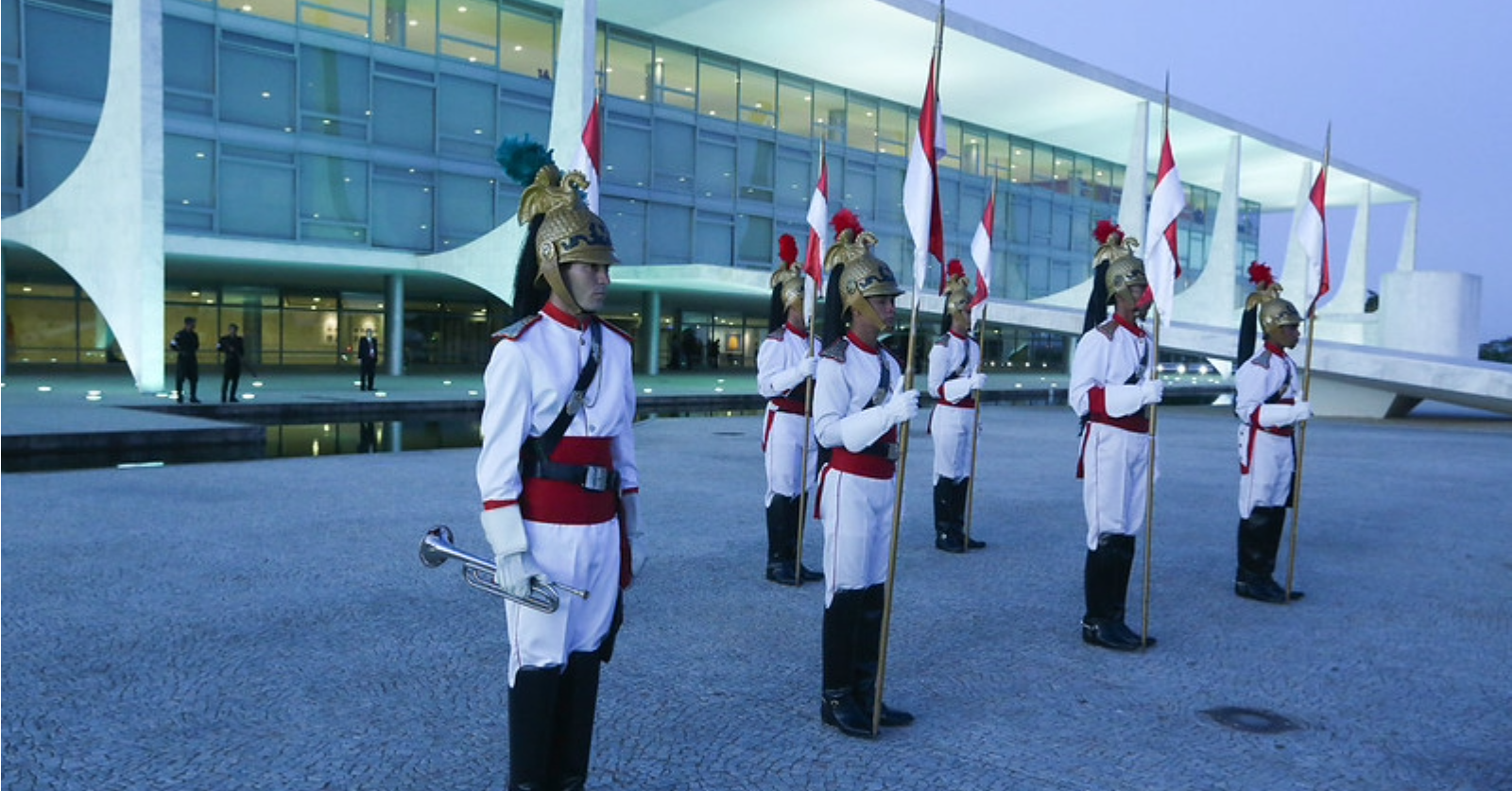
Main image by Michel Temer via Flickr- Creative Commons License (CC BY 2.0).
Further Reading
For additional perspectives on democratic crises, militarization, and governance challenges across Latin America, readers may also be interested in:
- When the Impossible Happened in Venezuela: Media, Political Discourse, and Lived Experience — A personal and political reflection on Venezuela’s democratic crisis and the transformation of everyday life under authoritarian pressures. The article offers insight into how political institutions and public discourse evolve during periods of democratic breakdown.
- Mexico Security Strategy: 18 Years After the War on Drugs — An analysis of how Mexico’s security policy gradually institutionalized military involvement in public security. The article examines how reliance on armed forces reshaped governance and institutional authority in Mexico.
- Violence in Latin America: Brazil’s Crisis and Regional Dynamics — A regional perspective on rising violence and institutional strain across Latin America, with particular attention to Brazil’s political and security challenges. The article situates Brazil’s crisis within broader hemispheric patterns of governance and militarization.
Editor’s Note: Originally published September 27, 2021. This version includes minor editorial revisions and references updated in 2026 for documentation and clarity. Some cited sources postdate the original publication.
References
Bogéa, D., & Guimarães, L. (2025). Rotating chief justices in a democracy under stress: The Brazilian Supremo Tribunal Federal under Bolsonaro. International Journal of Constitutional Law, 23(1), 263-278. https://doi.org/10.1093/icon/moaf011
Couto, C. G., & Arantes, R. B. (2008). Constitution, government and democracy in Brazil. World Political Science, 4(2). https://www.researchgate.net/profile/Claudio-Couto/publication/250148031_Constitution_Government_and_Democracy_in_Brazil/links/58f7c90faca272c34c3809ff/Constitution-Government-and-Democracy-in-Brazil.pdf
Razafindrakoto, M., Roubaud, F., Castilho, M. R., Pero, V., & Saboia, J. (2024). Investigating the “Bolsonaro effect” on the spread of the Covid-19 pandemic: An empirical analysis of observational data in Brazil. PloS One, 19(4), e0288894. https://doi.org/10.1371/journal.pone.0288894
Tanscheit, T., & Barbosa, P. (2023). A battle of two presidents: Lula vs. Bolsonaro in the Brazilian elections of 2022. Revista de Ciencia Política, 43(2), 167–191. https://www.scielo.cl/pdf/revcipol/2023nahead/0718-090X-revcipol-S0718-090X2023005000111.pdf
Vitelli, M. (2022). Back to basics: assessing military involvement in politics in contemporary Brazil. Brasiliana: Journal for Brazilian Studies, 10(2), 10-28. https://doi.org/10.25160/bjbs.v10i2.128162