

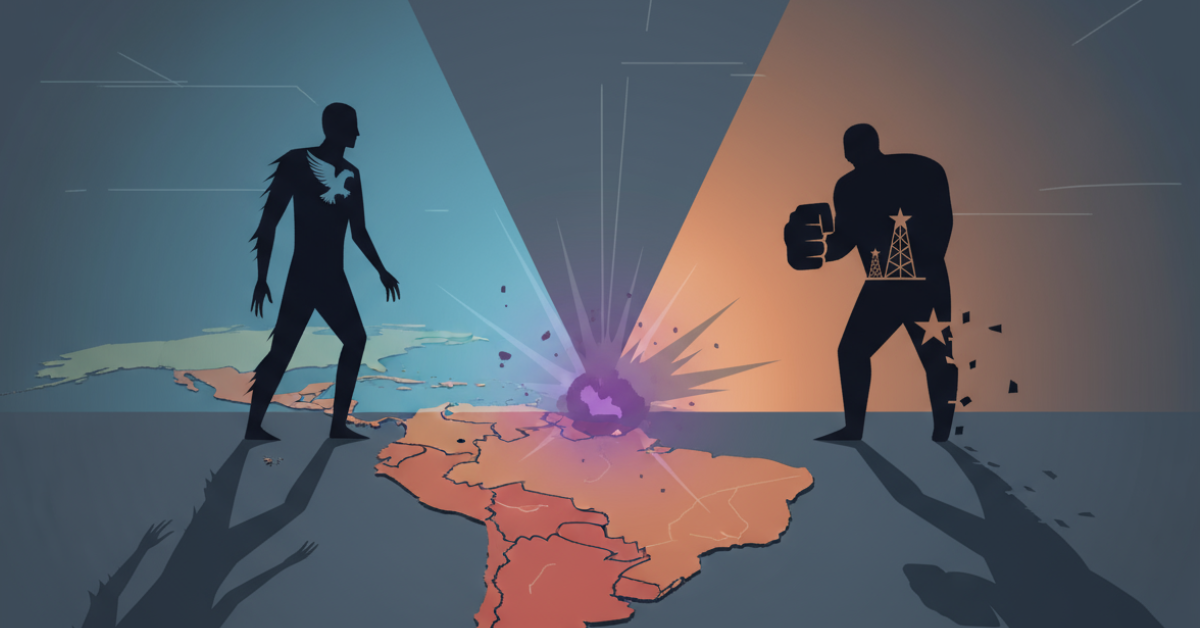
Historically, US interventions in Latin America have oscillated between the promise of stability and the reality of control. In the name of democracy, Washington has justified military actions, sanctions, and diplomatic pressure. Far from strengthening institutions, these measures have contributed to fragility and dependence in the region (Meernik, 1996).
This dynamic is also part of the democratic crisis in Latin America, a phenomenon that the Suru Institute has analyzed in depth. However, this type of US intervention created a culture of institutional dependence and set a dangerous precedent for Latin American sovereignty, as it validated the idea that the use of force could resolve internal political disputes. This tension between idealism and hegemony continues to shape hemispheric politics, even today (Daghrir, 2016; Jarquín, 2021).
Successes and failures of US interventions in Latin America
Beyond the fact that some analysts such as Doswald-Beck (2009), D’amato (1990), and Furlong (1993) emphasize that the operations in Grenada (1983) and Panama (1989) were considered successful or functional within the US narrative framework itself. The invasion of Panama achieved its immediate objectives—the removal of Manuel Noriega and the restoration of civil order. Even so, the credibility of the United States was damaged, as Lutz (1990) shows.
On the contrary, failed operations, such as the 1961 Bay of Pigs invasion, became a symbol of the limits of US power. The Cuban episode revealed Washington’s inability to understand local social dynamics and the depth of anti-interventionist sentiment in the region. Paradoxically, Cuba ended up strengthening its revolutionary narrative in the face of the superpower’s failure (Laykó, 2017; Zelikow, 2020).
Prolonged intervention in Haiti (1994–2010)
Haiti offers another paradigmatic example. The interventions from 1994 to 2010, promoted under the banner of “democratic reconstruction,” led to prolonged dependence on international organizations, further weakening the autonomy of the Haitian state. In this vein, so-called “supervised sovereignty” left the country trapped between perpetual assistance and the impossibility of full self-government. These episodes demonstrate how U.S. interventions in Latin America have had lasting impacts on political stability and states’ capacity to govern themselves.
Military presence and the legacy of US interventions in Latin America
The current US military and logistical presence in the Caribbean needs to be examined in the context of past experiences. The newly established US naval operations in the South Atlantic reflect traditional geostrategic control, even though they are framed as initiatives to combat drug trafficking. In reality, this military deployment serves a broader agenda of regime change (Military deployment is not an anti-drug operation: it is regime change, 2025).
Therefore, the presence of military ships and personnel must be understood within the context of global competition with China and Russia, as well as the legacy of US interventions in Latin America that influenced regional security during the 20th century.
Venezuela, sanctions, and US interventionism
In this scenario, Venezuela occupies a unique position. The sanctions policy implemented by Washington has not led to significant political changes, but it has caused a substantial deterioration in social conditions. The punitive measures have increased poverty and migration, mainly affecting the most vulnerable population. According to Oliveros (2021), a report by the Washington Office on Latin America (WOLA) states that the sanctions directly contributed to the profound decline and deterioration in the quality of life of Venezuelans.
From a structural perspective, the sanctions have functioned as a mechanism of political pressure. Therefore, they have operated more as an instrument of pressure than as a means of diplomatic negotiation. An analysis by Eland (2024) warns that the oil sanctions imposed by the United States succeeded in inflicting enormous damage on Venezuelan citizens without achieving any tangible results in terms of the political direction of Caracas. In addition, the sanctions contributed to deepening the flow of migration not only to Venezuela’s neighboring countries but also to the United States.
It is necessary to prevent the relationship between Caracas and Washington from becoming a partisan battleground within US politics. Turning Venezuela into an electoral banner for Democrats and Republicans not only distorts the reality of Venezuela but also hinders any progress toward a coherent and sustainable foreign policy. Venezuela must be understood from the perspective of state policy, not from electoral competition and partisan clashes between Republicans and Democrats.
Hemispheric cooperation and the limits of US interventionism
Historical experience shows that US interventions in Latin America have failed to resolve the region’s structural challenges. Latin America needs a new approach to security and cooperation. Policies focused on coercion, isolation, or the imposition of sanctions have proven ineffective. Only a strategy of mutual respect and regional coordination could lay the foundations for real hemispheric security. According to Torres, Solís, and Bello (2019), “regional cooperation mechanisms” have significant scope in the face of the Venezuelan crisis, suggesting that the multilateral approach has greater potential than unilateralism.
In this regard, the role of multilateral organizations and Latin American integration mechanisms is crucial in avoiding the strategic paternalism of the past. Furthermore, this does not mean denying the importance of the United States as a hemispheric actor. On the contrary, it is necessary to redefine its role.
The region needs equitable alliances and shared development projects. Washington, for its part, needs to understand that its influence in the region will only be legitimate if it is built on principles of cooperation rather than subordination, which are showing signs of exhaustion and, over time, have made Caracas more resilient to financial pressure and isolation mechanisms, as demonstrated by Aldana (2025) and Cazal (2025). US leadership must, therefore, evolve from interventionism to shared responsibility.
Lessons from history: dialogue on domination
The challenge, therefore, is not whether to intervene or not, but how to relate: with respect, strategic intelligence, and a willingness to build bridges. History shows that attempts to impose foreign models have only produced fractures and resentment. On the other hand, when the hemisphere has opted for dialogue and coordination, it has managed to overcome even the most turbulent times.
The examples of the Contadora Group (Mexico, Colombia, Venezuela, and Panama) and later the Esquipulas Support Group were paradigmatic examples of how Latin American regional diplomacy managed to contain armed conflicts in Nicaragua, El Salvador, and Guatemala without direct US military intervention. The Esquipulas process itself represented an initiative of autonomous regional diplomacy in which coordination among Central American countries partially displaced the role of external powers (Jarquin, 2021).
Ultimately, the historical balance of US interventions in Latin America confirms that imposition generates more instability than lasting solutions. That is the fundamental lesson that Latin America offers the United States today: that cooperation, not domination, is the true path to lasting stability.
Further Reading
To explore the historical evolution of U.S. interventionism and its contemporary implications for Venezuela and hemispheric security, readers may also be interested in:
- The Monroe Doctrine and U.S. Hegemony in Latin America — A historical analysis of the doctrine that framed U.S. influence in the Western Hemisphere for nearly two centuries. The article provides essential context for understanding how interventionist logic became institutionalized in U.S.–Latin American relations.
- When the Impossible Happened: Venezuela — A reflection on Venezuela’s political trajectory and the structural factors that shaped its crisis. This piece complements the discussion of sanctions and sovereignty by examining internal institutional dynamics alongside external pressure.
- U.S. Intervention in Venezuela After Maduro — A forward-looking assessment of possible policy scenarios in a post-Maduro context. The analysis explores the risks of regime-change strategies and the long-term implications for regional stability.
References
Aldana, B. (2025). Informe Especial: El sistemático proceso de evasión de sanciones. Misión Verdad. https://www.misionverdad.com/investigaciones/informe-especial-el-sistematico-proceso-de-evasion-de-sanciones
Berger, H. (2025, 18 de octubre). Venezuela Regime Change Helps Exxon—not Americans. The American Conservative. www.theamericanconservative.com/venezuela-regime-change-helps-exxon-not-americans/
Cazal, E. (2025). Sanciones y aranceles contra Venezuela: los desafíos son oportunidades. Misión Verdad. https://www.misionverdad.com/venezuela/sanciones-y-aranceles-contra-venezuela-los-desafios-son-oportunidades
D’Amato, A. (1990). The Invasion of Panama Was a Lawful Response to Tyranny. The American Journal of International Law, 84(2), 516–524.
Daghrir, W. (2016). The United States’ “Realist” Foreign Policy: Operation Just Cause in Panama as a Case Study. Journal of Arts and Humanities, 5(5), 30-37. www.theartsjournal.org/index.php/site/article/view/941
Despliegue militar no es una operación antidrogas: es un cambio de régimen. (2025, 23 de octubre). Mision Verdad. http://misionverdad.com/venezuela/despliegue-militar-no-es-una-operacion-antidrogas-es-un-cambio-de-regimen
Doswald‑Beck, L. (2009). “The Legality of the United States Intervention in Grenada.” Netherlands International Law Review, 31(3), 355‑377.
Eland, I. (2024, 5 de mayo). A Missed Off-Ramp for U.S. Venezuela Policy. The American Conservative. www.theamericanconservative.com/a-missed-off-ramp-for-failed-u-s-policy-toward-venezuela/
Furlong, W. L. (1993). Panama: The Difficult Transition towards Democracy. Journal of Interamerican Studies and World Affairs, 35(3), 19–64.
Gilboa, E. (1995). The Panama Invasion Revisited: Lessons for the Use of Force in the Post Cold War Era. Political Science Quarterly, 110(4), 539–562.
Jarquín, M. (2021). Contadora and the Latin American response to US intervention against the Sandinistas, 1982-86. The Americas, 78(4), 581-608. Cambridge University Press.
Laykó, D. (2017). Causes of the Bay of Pigs invasion’s failure. Corvinus Journal of International Affairs, 2(1), 43‑55.
Lutz, W. (1990). Doublespeak, the Invasion of Panama, and the Corruption of Public Discourse. The North American Review, 275(2), 56–57.
Meernik, J. (1996). United States Military Intervention and the Promotion of Democracy. Journal of Peace Research, 33(4), 391–402.
Oliveros, L (2020). Impacto de las sanciones financieras y petroleras sobre la economía venezolana. WOLA. www.wola.org/wp-content/uploads/2020/10/Oliveros-informe-completo-2.pdf
Torres, V., Solís, J., & Bello, A. (2019). Alcance de mecanismos de cooperación regional frente a la crisis política en Venezuela. Revista De Ciencias Sociales, 25, 208-223.
Zelikow, P. (2000). American Policy and Cuba, 1961‑1963. Diplomatic History, 24(2), 317‑334.