

Abstract
This article analyzes criminal governance in Venezuela as a hybrid form of territorial power in which armed groups and criminal structures exercise functions traditionally associated with the state. Drawing on theoretical contributions related to criminal governance, territorial control, and illicit economies, the article examines how Organized Crime Structured Groups (GEDO) participate in extortion mechanisms, economic regulation, and the informal administration of social order. It argues that these dynamics cannot be understood solely as expressions of state absence or criminal deviance, but rather as complex configurations of coexistence, negotiation, and territorial control between state and non-state actors. The article also explores regional variations in criminal governance across mining zones, border regions, and urban centers, highlighting how extractive economies, smuggling networks, and informal markets shape distinct forms of local authority and regulation. Finally, it argues that the traditional distinction between the state and criminality is insufficient for understanding contemporary power dynamics in Venezuela.
Keywords: criminal governance in Venezuela, armed groups in Venezuela, territorial control, organized crime, extortion economies, illicit economies, hybrid governance, GEDO
Venezuela is no longer governed exclusively through the traditional model of state authority. In recent years, the concept of criminal governance has gained prominence among analysts seeking to explain forms of territorial power in which armed groups exercise functions traditionally associated with the state, shaping a complex social and political landscape.
This article examines how Organized Crime Structured Groups (GEDO) have developed a hybrid model of criminal governance in Venezuela and how these structures influence the country’s economy and the daily lives of its population.
What Is Criminal Governance?
Criminal governance refers to a situation in which organized and armed groups exercise actual authority and assume roles traditionally associated with the state. For governance to exist, there must be established rules that define what actions are permitted and prohibited, who is allowed to sell goods, and which routes can or cannot be used.
There must also be actors capable of punishing those who violate the rules and “providing protection” to those who comply with them. Finally, there must be mechanisms for resolving disputes involving permits, neighborhood conflicts, or freedom of movement, among other issues. Organized criminal groups in Venezuela currently carry out many of these functions.
In this sense, the concept of criminal governance offers an alternative interpretation to traditional perspectives that understood organized crime primarily as the result of state absence or as a purely illicit activity. Rather than representing a simple form of criminal deviance, criminal governance constitutes a new form of social and territorial order (Lessing, 2020).
From this perspective, power is exercised collectively and does not necessarily imply direct conflict with the state. Nor is this control inherently chaotic; rather, it is often organized and structured. In his analysis of Rio de Janeiro’s favelas, Enrique Desmond Arias (2006) argues that criminal networks frequently maintain complex relationships with political, police, and community actors, integrating themselves into broader social and political systems.
As this suggests, interaction within criminal governance need not lead to confrontation. However, it can instead involve forms of mutual tolerance and negotiation through which different actors generate social order.
Territorial Control and Extortion Economies in Venezuela
Criminal governance cannot be understood solely as the presence of armed actors operating outside the law. Rather, it involves a reconfiguration of power in which coercion is distributed among multiple authorities and through which territorial control and extortion economies operate.
In this context, extortion is not simply a common crime, but a mechanism for obtaining and managing economic resources through coercion. For example, transport workers, merchants, and other local actors may be required to make payments (“vacunas”) to armed groups in exchange for guarantees that their commercial activities can continue.
In some contexts, these groups rely not only on coercion but also develop informal mechanisms for mediation and conflict resolution, helping regulate local economic and social dynamics. Their ability to establish predictable rules and maintain a degree of continuity in economic activity can generate pragmatic acceptance among certain segments of the population, even when these structures operate outside formal legal systems. As Uribe, Lessing, Schouela, and Stecher (2025) argue, some criminal organizations seek to present themselves as providers of order and protection.
Within this framework, the state is not necessarily the opposite of this form of violence. In fact, scholars such as Charles Tilly (1985) argue that states historically exercised dynamics of coercion and protection comparable to those of criminal organizations that offered protection in exchange for resources. Today, these groups transform extortion into a predictable “security tax.”
Tilly writes:
“If protection rackets represent organized crime at its smoothest, then war making and state making — quintessential protection rackets with the advantage of legitimacy — qualify as our largest examples of organized crime” (p.169).
In Venezuela, these dynamics manifest through the coexistence of state security forces and structured armed groups that participate in the administration of territorial control.
According to Felbab-Brown (2017), many studies have relied on simplistic interpretations that portray a one-directional relationship between the state and criminality, as well as between illicit economies and international order. However, she argues that activities considered illegal in the international sphere can acquire local legitimacy when armed actors provide protection, order, or economic stability, thereby allowing them to consolidate as influential power brokers and even political actors.
How Armed Groups Operate in Venezuela
Territorial control is central to criminal governance. More than a geographic space, territory functions as a mechanism through which power relations are organized and social dynamics are regulated.
As Robert Sack (1986) argues, human territoriality “is not an instinct, but a powerful geographical strategy to control people and things by controlling area.” In this sense, the territorial control exercised by armed groups involves the ability to intervene in local economies, mobility, and other forms of social interaction.
In Venezuela, particularly in the state of Zulia, producers and merchants are often required to pay a “vacuna,” which is not an occasional robbery but rather a fixed operational cost. Depending on the size of the business and the production volume, the GEDO determines the amount to be paid. In exchange, these groups offer assurances that smaller criminal actors will not “harass” those who comply.
In this way, a monopoly of protection is established, allowing economic activities to continue while ensuring compliance with the rules imposed by the GEDO.
Regional Variations in Criminal Governance
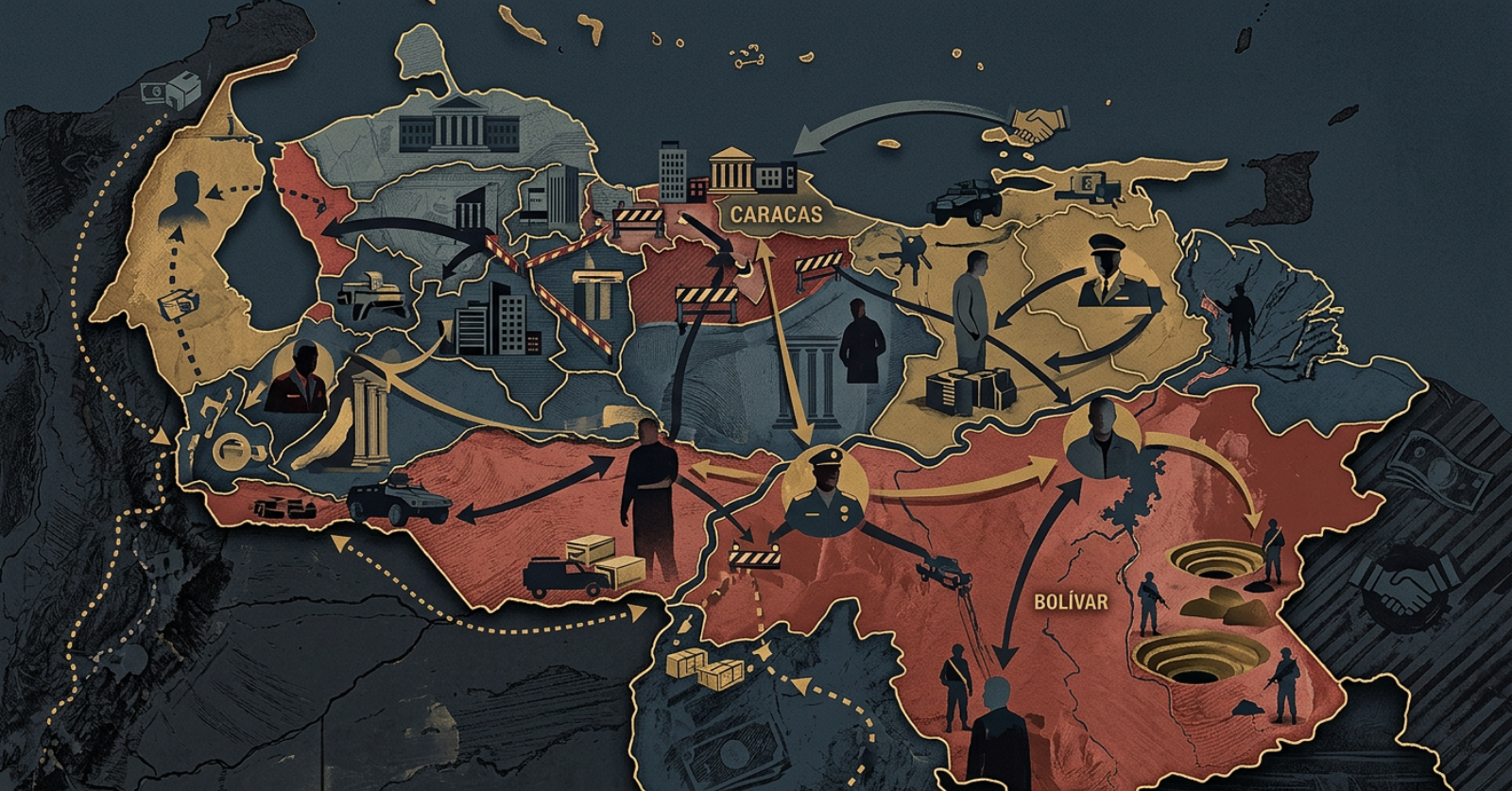
In Venezuela, the dynamics of territorial control and extortion by armed groups are unevenly distributed. Multiple groups may coexist in the same region, although one may dominate, and alliances can shift over time.
In mining zones, territorial control tends to revolve around extractive economies, strategic corridors, and disputes over access to mineral resources (Ebus & Martinelli, 2022). In border regions, dynamics are shaped by smuggling, cross-border mobility, and illicit routes, with various armed groups seeking to regulate the movement of people and goods (García Pinzón & Mantilla, 2021). Meanwhile, in some urban centers, specific groups impose local regulation through informal markets, extortion schemes, and mechanisms of territorial control (Antillano, Arias, & Zubillaga, 2020).
These variations demonstrate that criminal governance in Venezuela does not conform to a single model. Instead, it reflects distinct territorial configurations that adapt to each region’s economic and social conditions.
Criminal Governance and Everyday Life
Territorial configurations vary by region and the predominant economic type. Individuals transporting food products are often required to pay fees at informal “checkpoints,” where the authority behind the payment is not always clear. Regardless of the uniform they wear, transport workers are frequently expected to pay to continue their route. An article published by InSight Crime and updated in June 2025 notes that the Tren del Llano remained a key actor in central Venezuela and that, together with the Tren de Aragua, both groups maintained territorial coexistence agreements.
In another investigation, the Observatorio Venezolano de Violencia identified twelve criminal groups dedicated to extortion operating across different municipalities in the state of Zulia, including El Conas, El Adriancito, Yeico Masacre, and others.
Finally, a report by Transparencia Venezuela suggests possible involvement of government agencies in criminal activities, which may contribute to processes of deinstitutionalization and to declining public trust in certain regions of the country.
Conclusion
The phenomenon of organized crime and criminal governance should not be analyzed in simplistic terms. In the Venezuelan case, organized crime does not operate solely as an external actor, but as part of a hybrid governance structure in which functions of control, regulation, and coercion vary territorially among different actors.
Within this context, the traditional distinction between the state and criminality becomes insufficient for understanding Venezuela’s contemporary social and political dynamics, since both coexist and interact within the same social space. Although these illicit economies may produce certain forms of local stability or regulation, this does not imply democratic legitimacy or effective protection of rights. Precisely because of this complexity, dismantling these systems may require gradual weakening strategies rather than direct confrontations that, in some cases, could generate unintended consequences.
Recommended Reading
To further explore criminal governance, territorial control, and violence dynamics in Latin America, readers may also consult:
- Communal Councils in Venezuela — An analysis of the origins, institutional structure, and political role of Venezuela’s Communal Councils within the broader Chavista project. The article examines how these organizations contributed to hybrid forms of local governance and coexistence between state institutions and parallel mechanisms of power.
- Drug Trafficking Routes in Latin America — A study of major drug trafficking routes and the transnational dynamics of organized crime across the region. The analysis helps contextualize how illicit economies, borders, and strategic corridors influence contemporary forms of territorial control.
- Violence in Latin America: The Case of Brazil — A regional perspective on violence, criminality, and state responses in Latin America. The article situates Venezuelan dynamics within broader hemispheric patterns of governance, militarization, and territorial control.
References
Antillano, A., Arias, E. D., & Zubillaga, V. (2020). Violence and territorial order in Caracas, Venezuela. Political Geography, 82, 102221. https://doi.org/10.1016/j.polgeo.2020.102221
Arias, E. D. (2006). The dynamics of criminal governance: Networks and social order in Rio de Janeiro. Journal of Latin American Studies, 38(2), 293–325. https://doi.org/10.1017/S0022216X06000721
Ebus, B., & Martinelli, T. (2022). Venezuela’s gold heist: The symbiotic relationship between the state, criminal networks and resource extraction. Bulletin of Latin American Research, 41(4), 561–576. https://doi.org/10.1111/blar.13246
Felbab-Brown, V. (2017). Organized crime, illicit economies, civil violence and international order: More complex than you think. Daedalus, 146(4), 98–111. https://doi.org/10.1162/daed_a_00462
García Pinzón, V., & Mantilla, J. (2021). Contested borders: Organized crime, governance, and bordering practices in Colombia–Venezuela borderlands. Trends in Organized Crime, 24(3), 265–281. https://doi.org/10.1007/s12117-020-09399-3
InSight Crime. (2025, June 5). Tren del Llano. InSight Crime. https://insightcrime.org/es/noticias-crimen-organizado-venezuela/tren-llano/
Lessing, B. (2020). Conceptualizing criminal governance. Perspectives on Politics, 19(3), 854–873. https://doi.org/10.1017/S1537592720001243
Observatorio Venezolano de Violencia. (2023, August 23). 25 víctimas fatales han dejado las extorsiones en el Zulia. Observatorio Venezolano de Violencia. https://observatoriodeviolencia.org.ve/news/25-victimas-fatales-han-dejado-las-extorsiones-en-el-zulia/
Sack, R. D. (1986). Human territoriality: Its theory and history. Cambridge University Press.
Tilly, C. (1985). War making and state making as organized crime. In P. B. Evans, D. Rueschemeyer, & T. Skocpol (Eds.), Bringing the state back in (pp. 169–191). Cambridge University Press.
Transparencia Venezuela. (2023, August 7). Agentes criminales, interacciones oscuras. Transparencia Venezuela. https://transparenciave.org/economias-ilicitas/agentes-criminales-interacciones-oscuras/
Uribe, A., Lessing, B., Schouela, N., & Stecher, E. (2025). Criminal governance in Latin America: Prevalence and correlates. Perspectives on Politics, 24(1), 124–142. https://doi.org/10.1017/S1537592725101849