

“Truth is stranger than fiction.”
— Mark Twain (1897)
The Loss of Wonder in the Face of the Extraordinary
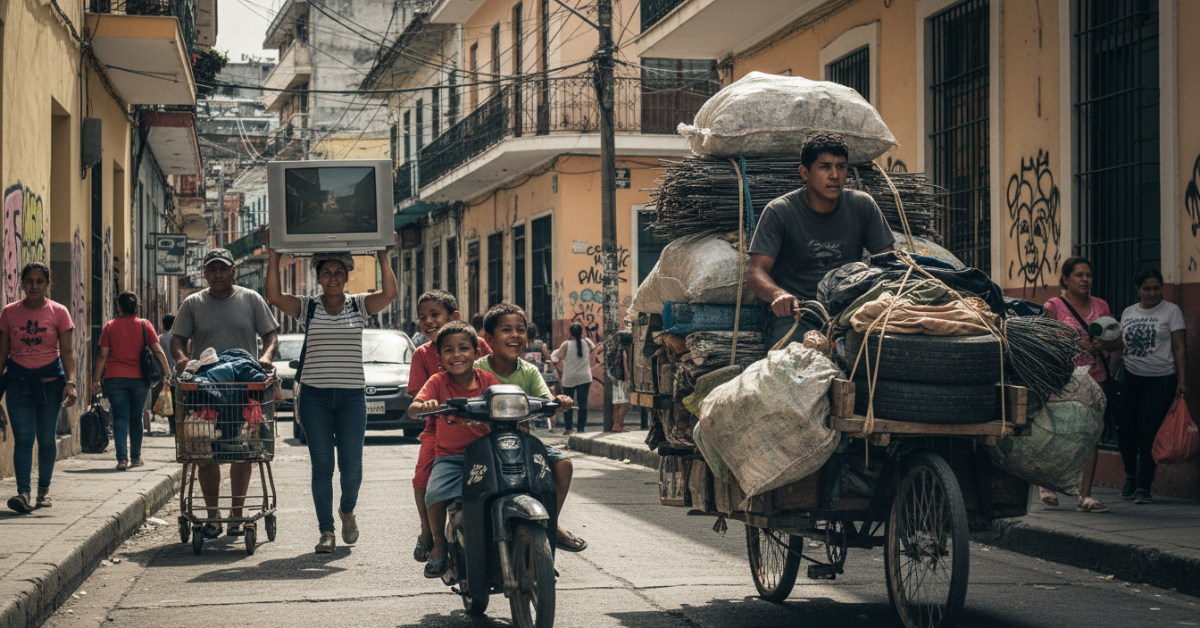
Amid the nuances of everyday life, surprise and wonder tend to fade in the face of situations that, in other contexts, might be perceived as completely outside the norm. In this sense, social resilience in Latin America becomes particularly visible through the routines and practices of daily life. For various reasons, countless circumstances chart paths toward solving problems through improvisation, ingenuity, and, of course, mutual support. These are hallmarks of everyday life in Latin America.
It is no longer surprising to walk down the street and see four people traveling on a single motorcycle. Nor is it unusual to observe women, no matter how slender they may appear, carrying enormous containers of water up staircases, or to see a car from the 1980s still running and offered for sale. Daily life unfolds this way in many localities, in both urban and developed areas, and in rural and peripheral zones, to varying degrees. No one has been entirely exempt from these realities that shape everyday life in contexts of crisis and constraint.
Everyday Creativity as a Strategy for Survival
In a context of constant political, economic, and social crises, people do not only seek to survive. Through complex processes, they transform and reconfigure their practices: social norms are restructured, and informal arrangements emerge that sustain everyday life. What may initially appear as chaos is not necessarily so; these forms of everyday adaptation in Latin America acquire meaning insofar as they represent concrete solutions to specific problems (Weber, 2023).
Beyond a succession of unfavorable events, Latin America faces a deep, long-standing structural crisis that extends far beyond public policy formulation or the budget of the president of the day (Delgado, 2020). It is the constant confrontation with these limitations that creates space for communities to engage with everyday resilience in Latin America as both a practical response and a form of social organization embedded in daily routines.
There are multiple definitions of resilience. From the perspective of Torres Lima et al. (2021):
“Resilience in a socio-ecological context essentially consists of the capacity to recover from a disturbance. Complementarily, this concept refers to transformability, understood as the capacity to create a fundamentally new system when ecological, economic, or social structures render the existing system unsustainable.”
Social Resilience in Latin America: Addressing the Urgent When Institutions Fall Short
Although a resilient territory may display virtuous traits, these capacities often arise as adaptive responses to adverse situations generated by the limited or unreliable functioning of public institutions. In such scenarios, people are compelled to rely on available resources to create alternatives that allow them to continue their lives, even when these alternatives are not always the safest or most appropriate. In this sense, the relationship between institutions and informality in Latin America becomes central to understanding how social resilience is sustained in practice.
When institutions responsible for guaranteeing social order lack the capacity, coordination, or credibility needed to ensure basic resources and services, a rupture occurs in the foundations of social life. This situation increases vulnerability, precarity, and poverty, even in contexts where the state maintains a significant formal presence (Preciado Ramírez et al., 2024).
When such conditions cease to be exceptional and persist over time, chaos is no longer perceived as a crisis. Still, it becomes part of a new condition understood as “normal”—one that reshapes expectations, behaviors, and social norms in everyday life in Latin America.
As Cuervo Rodríguez et al. (2007) note:
“In this way, vulnerability manifests itself in how we position ourselves in relation to the circumstances that shape our relationships and, in turn, allow for a new organization of structures, hierarchies, meanings, and dilemmas.”
Resilience: Adaptation, Transformability, and Survival
Seeing farm animals moving through cities, turning to online channels to repair household appliances, or modifying diets according to available products are just some examples of the ingenuity and adaptive capacity that people develop to face adverse situations. Far from being merely anecdotal, these practices show how social resilience in Latin America manifests through the reorganization of everyday life when habitual conditions become unsustainable.
In the Latin American context, improvisation becomes functional. What once seemed impossible becomes normalized, and new forms of practical knowledge emerge, allowing daily routines to be sustained. Paying attention to these elements is, ultimately, a way of understanding how societies resist, adjust, and continue, even when everything appears to be working against them.
Further Reading
To expand the analysis of everyday life, social practices, and forms of adaptation that emerge in contexts of institutional fragility, the following articles may be of interest:
- Social cohesion: identifying social problems across Latin American countries — A comparative analysis of how institutional and social differences shape cohesion, trust, and collective response capacity across the region.
- Language as a tool for social transformation — A reflection on the role of language in constructing shared meanings, reorganizing social practices, and facilitating change in contexts of inequality and vulnerability.
- Ancestral culture and local economy — An exploration of how traditional knowledge and local economies contribute to community resilience and everyday adaptation in the face of structural constraints.
References
Banco Interamericano de Desarrollo. (2022). Construyendo resiliencia: lecciones aprendidas en América Latina y el Caribe. https://doi.org/10.18235/0004061
Cuervo Rodríguez, J. J., De la Hortúa, Y. P., & Gil Chibuque, G. P. (2007). Comprensiones en torno a la resiliencia desde la política pública y textos de algunas organizaciones no gubernamentales con sede en Bogotá que trabajan con familias en situación de vulnerabilidad. Diversitas, 3(2).
https://pepsic.bvsalud.org/scielo.php?script=sci_arttext&pid=S1794-99982007000200013
Delgado, R. G. M. (2020). Poverty, inequality, and vulnerability in Latin America (2000–2020). Americanía: Journal of Latin American Studies, (11), 56–90. https://doi.org/10.46661/americania.5200
Preciado Ramírez, J. D., Chamorro Quiñónez, J. G., Morán Villamarín, E. D., & Proaño González, E. A. (2024). Economic resilience in Latin America: projections and trends in overcoming crises and the path toward development. Journal of Economic and Social Science Research, 4(4), 136–152. https://doi.org/10.55813/gaea/jessr/v4/n4/138
Torres Lima, P., Torres Vega, P., & Castro Garza, G. (2021). Informal settlements and community resilience: itineraries for disaster risk assessment. Journal of Cities, States and Politics, 8(1), 129–146.
https://dialnet.unirioja.es/servlet/articulo?codigo=8961405
Vera-Bachmann, D. (2015). Resilience, poverty, and rurality. Revista Médica de Chile, 143(5), 677–678.
https://doi.org/10.4067/S0034-98872015000500018
Weber, M. M. (2023). The relationship between resilience and sustainability in the organizational context: a systematic review. Sustainability, 15(22), 15970. https://doi.org/10.3390/su152215970