

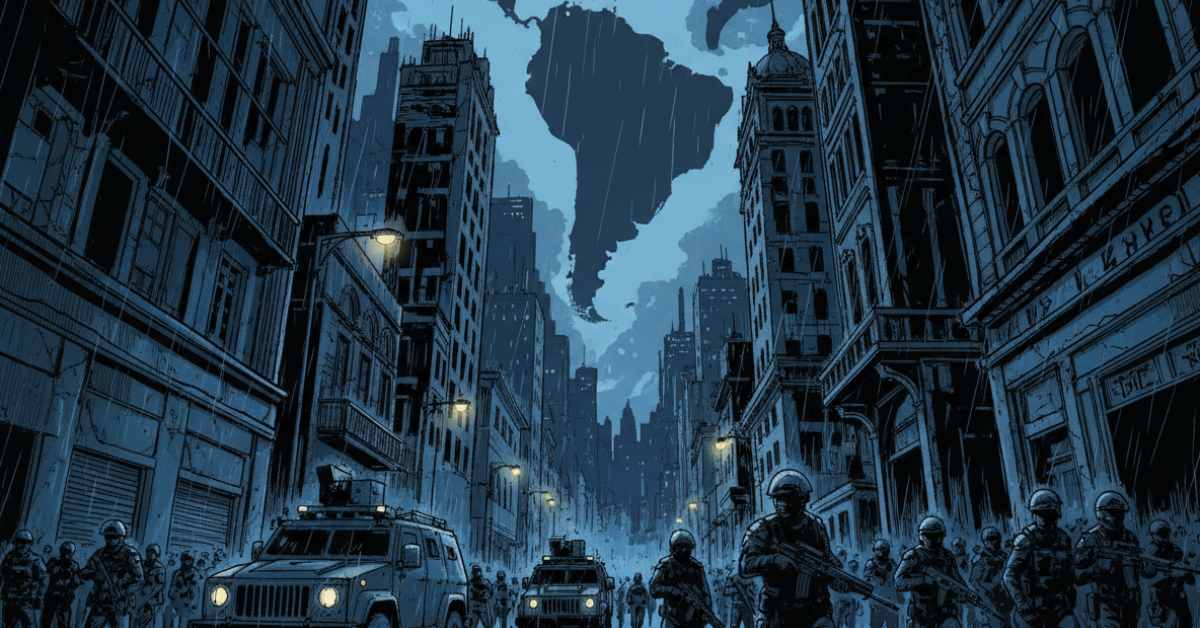
Violence in Latin America and Brazil’s Role
Brazil does not have the death penalty, but the behavior of its security forces often seems to contradict that fact. This illustrates part of the broader violence in Latin America. Data from the 2025 Brazilian Public Security Yearbook shows that in 2024, police interventions killed 6,243 people (Folha de S.Paulo, 2025). That figure has remained stable since 2018 and now totals 60,394 deaths over the last decade.
The recent Operation Contención, carried out in Rio de Janeiro in October 2025, reignited the debate. More than 2,500 officers were deployed. Armed helicopters flew over dense urban neighborhoods. The preliminary death toll reached 121 people. As a result, discussions about the limits of police action intensified once again within the wider context of violence in Latin America.
Territorial Inequality in Violence in Latin America
The territorial distribution of police lethality in Brazil reveals a sharply unequal map. In 2024, Amapá recorded 45.1 deaths per 100,000 inhabitants (Narcisa, 2025), and roughly one in three was caused by police. In Bahia, the proportion reached nearly one in four. In Pará, it approached one in five.
However, historically more stable states such as São Paulo and Minas Gerais saw surprising increases of 60.9% and 45.5%, respectively. Rio de Janeiro was the exception. There, lethality dropped by 9.5%, a decline analysts attributed to court-imposed restrictions on the use of police helicopters. These limits curtailed especially aggressive operations, shifting part of the overall landscape of violence in Latin America.
A Pattern Extending Beyond Major Cities
Out of Brazil’s 5,570 municipalities, 1,226 recorded at least one death caused by police action in 2024 (Fórum Brasileiro de Segurança Pública, 2025). This territorial spread shows that the phenomenon extends far beyond major urban centers and reflects dynamics linked to violence in Latin America.
In Santos and São Vicente (São Paulo), following Operation Escudo, an intensive campaign of patrols and incursions, two-thirds of all violent deaths were caused by state agents. The victims followed a familiar national pattern: 99.2% men, 82% Black, and disproportionately young, especially those aged 18 to 24.
Children and adolescents were also affected. Police were responsible for one in every five violent deaths of youths aged 12 to 17. This figure raised alarms among child-protection organizations and deepened debates on violence in Latin America.
A Policing Model Without a Complete Cycle
Brazil’s policing structure helps explain part of this situation. The country maintains two separate institutions that operate almost as independent systems. The Military Police is responsible for armed patrol. The Civil Police handles criminal investigations.
This separation prevents the “full police cycle” seen in countries such as the United States, Denmark, and Portugal. Moreover, Military Police officers are tried in their own military courts, reducing civilian oversight and reinforcing perceptions of impunity.
In 2024, approximately eleven states were using body-worn cameras (Duarte, 2024). Even so, international evidence shows that this technology reduces lethal incidents and abuses—an essential factor in addressing violence in Latin America.
Operation Contención: Occupation Tactics and a Wartime Logic
Operation Contención (Amnesty International, 2025) followed a familiar script: extended territorial occupation, blocked streets, mass searches, and the use of heavy weaponry in densely populated areas.
Images circulating during those days resembled a battlefield more than a standard police operation. Various organizations reported service interruptions, school closures, and severe mobility restrictions across the Penha and Alemão complexes. They also warned of the risk of collateral victims due to the lack of clear protocols governing airborne use of force.
This type of intervention reinforces the ongoing debate about violence in Latin America and the human costs of militarized policing (Carvalho, 2021).
A Pattern Repeated Across Several Latin American Countries
These large-scale operations are not unique to Brazil. Violence in Latin America appears in similar forms elsewhere.
- Mexico: Since 2022, the National Guard has been progressively placed under military control (Raziel, 2024). Multiple reports have also noted a rise in arbitrary detentions (Bravo Govea, 2021). By 2025, a significant number of military personnel were engaged in public-security operations.
- Colombia: The homicide rate closed 2024 at 25.4 per 100,000 inhabitants (Manjarrés, Newton, & Cavalari, 2025). According to Temblores ONG (2025), the GRITA Platform recorded 109 cases of police violence and at least 144 victims during 2024. Many of these abuses occurred in departments with illegal economies, such as Arauca, Chocó, and Cauca. These same regions experienced increases in military operations and in complaints about abuses committed by security forces.
- Ecuador: Between 2024 and 2025, the country underwent an unprecedented wave of militarization. After the surge in violence in January 2024, the government issued multiple consecutive states of exception and expanded the role of security forces in internal control. According to Amnesty International, President Daniel Noboa reported 34,952 arrests in the early months of the crackdown, while press data indicated that 10,000 people were detained between January and February, though only 5% were processed (Amnistía Internacional, 2024). Human-rights groups have warned that many detentions occurred without judicial warrants, using an expanded interpretation of “flagrancy,” and involved police violence, physical abuse, and due-process violations.
- Argentina: In 2025, police violence in the context of protests rose significantly. According to the Provincial Commission for Memory, 1,251 people were injured by police repression in just six months, more than the total number recorded in all of 2024. In that same period, 130 arbitrary detentions were documented compared to 93 the previous year (Comisión por la Memoria, 2025). Federal and Buenos Aires City security forces repressed more than half of all public demonstrations, applying the “anti-picket” protocol with disproportionate use of less-lethal weapons, detentions during dispersals, and illegal intelligence activities.
These dynamics show that violence in Latin America is closely tied to institutional and legal changes across the region.
Debate Over Brazil’s Antifacción Bill
In Brazil, the Antifacción bill is moving quickly through Congress. It proposes harsher penalties for crimes linked to organized groups, including sentences of up to 40 years for leaders who use heavy weaponry.
The bill also expands asset seizures, authorizes audiovisual monitoring, and creates special regimes for “high-risk” detainees.
However, legal experts and civil-society organizations criticize the bill for lacking clear guidelines for judicial oversight. They warn of legal contradictions and the risk of overwhelming an already strained prison system.
Both the federal government and the Federal Police raised objections to changes proposed by rapporteur Guilherme Derrite. They argued that the modifications weaken investigative capacities and could inadvertently benefit criminal factions. They also expressed concern over the creation of biometric databases without strong safeguards, which is a serious issue in the broader debate on violence in Latin America.
Growing Risks for Police and Military Forces
Organized crime also heightens risks for state agents. In Rio de Janeiro, a large-scale police operation in 2025 left at least four officers and dozens of civilians dead (Galarraga Gortázar, 2025). It was described as the most lethal action of its kind in the state’s history.
In Mexico, official data reported increases in attacks against military personnel between 2023 and 2024. Colombian human-rights organizations also documented assaults by armed groups on police forces and other security units during 2024.
Three Trends Moving in Parallel Across Latin America
The regional landscape shows three simultaneous trends:
- A growing number of lethal police and military interventions
- Increasing military involvement in domestic security
- Weakening civilian oversight mechanisms
However, the evidence shows that militarization does not sustainably reduce homicide rates. Studies from the Inter-American Development Bank and national statistics institutes reveal that countries with greater military deployments did not achieve proportional reductions in violent crime over the past decade.
A Model Based on Permanent Exceptionalism
In Brazil, persistently high numbers of deaths from police actions and recurring large-scale operations have created a model that operates under a logic of permanent exception.
What occurs in Rio de Janeiro, Mexico City, Guayaquil, or Cali cannot be explained solely by organized crime. Instead, it reflects state models that prioritize high-impact interventions rather than integrated strategies of prevention, investigation, and external oversight.
For all these reasons, these dynamics form part of a broader discussion about violence in Latin America.
Further Reading
For additional analysis on militarization, institutional reform, and punitive governance in Latin America, readers may also be interested in:
- Mexico’s Security Strategy — An examination of how expanding military participation in public security has reshaped institutional authority in Mexico. The article analyzes the long-term consequences of relying on armed forces for domestic order and provides deeper context for understanding the regional turn toward militarized governance.
- Mass Incarceration in Democracies: The United States and Argentina — A comparative analysis of how democratic systems can expand punitive institutions without abandoning formal constitutional frameworks. This piece complements the discussion of policing and militarization by exploring how incarceration becomes normalized within democratic regimes.
- Police and Corruption in Mexico: Paths and Proposals — A structural assessment of policing weaknesses, corruption networks, and accountability gaps. The article highlights why sustainable violence reduction depends on strengthening civilian institutions rather than simply expanding coercive capacity.
References
Amnistía Internacional. (2024, October). Información para el Comité de Derechos Humanos de la ONU: Ecuador (AMR2885312024). https://www.amnesty.org/es/wp-content/uploads/sites/4/2024/10/AMR2885312024SPANISH.pdf
Amnesty International. (2025, November 3). Brasil: Masacre policial en Río de Janeiro evidencia nuevamente violencia sistémica y racista. https://www.amnesty.org/es/latest/news/2025/11/brasil-masacre-policial-en-rio-de-janeiro-evidencia-nuevamente-violencia-sistemica-y-racista/
Carvalho, J. A. G. S. (2021, September 27). Brazil’s sociopolitical cataclysm: The dangers of unchecked military institutions. Suru Institute. https://suruinstitute.com/brazils-sociopolitical-cataclysm-the-dangers-of-unchecked-military-institutions/
Comisión por la Memoria. (2025, July 23). Represión acelerada: en seis meses hubo más personas heridas y detenidas que en todo el 2024. https://www.comisionporlamemoria.org/represion-acelerada-en-seis-meses-hubo-mas-personas-heridas-y-detenidas-que-en-todo-el-2024/
Duarte, D. E. (2024, March 27). Brazil’s ongoing struggle with police violence. Urban Violence. https://urbanviolence.org/brazils-ongoing-struggle-with-police-violence/
Folha de S.Paulo. (2025, July). Muertes violentas en Brasil llegan al mínimo histórico pero letalidad policial sigue alta. https://www1.folha.uol.com.br/internacional/es/brasil/2025/07/muertes-violentas-en-brasil-llegan-al-minimo-historico-pero-letalidad-policial-sigue-alta.shtml
Fórum Brasileiro de Segurança Pública. (2025). Anuário Brasileiro de Segurança Pública 2025 (19ª ed.). https://forumseguranca.org.br/publicacoes/anuario-brasileiro-de-seguranca-publica/
Galarraga Gortázar, N. (2025, October 29). Los vecinos de Río de Janeiro hallan más de 60 cadáveres tras la megaoperación contra el crimen organizado. El País. https://elpais.com/internacional/2025-10-29/los-vecinos-de-rio-de-janeiro-hallan-mas-de-60-cadaveres-tras-la-megaoperacion-contra-el-crimen-organizado.html
Manjarrés, J., Newton, C., & Cavalari, M. (2025, February 26). Balance Insight Crime: homicidios 2024. InSight Crime. https://insightcrime.org/es/noticias/balance-insight-crime-homicidios-2024/
Narcisa, T. (2025, July 24). Amapá, Bahia e Pará têm as polícias mais letais do Brasil, aponta estudo. CNN Brasil. https://www.cnnbrasil.com.br/nacional/brasil/amapa-bahia-e-para-tem-as-policias-mais-letais-do-brasil-aponta-estudo/
Raziel, Z. (2024, September 19). México inicia la entrega de la Guardia Nacional al control del ejército. El País. https://elpais.com/mexico/2024-09-20/mexico-inicia-la-entrega-de-la-guardia-nacional-al-control-del-ejercito.html
Temblores ONG. (2025, February 26). Reporte de hechos de violencia policial en Colombia durante 2024. https://www.temblores.org/post/reporte-de-hechos-de-violencia-policial-en-colombia-durante-2024