

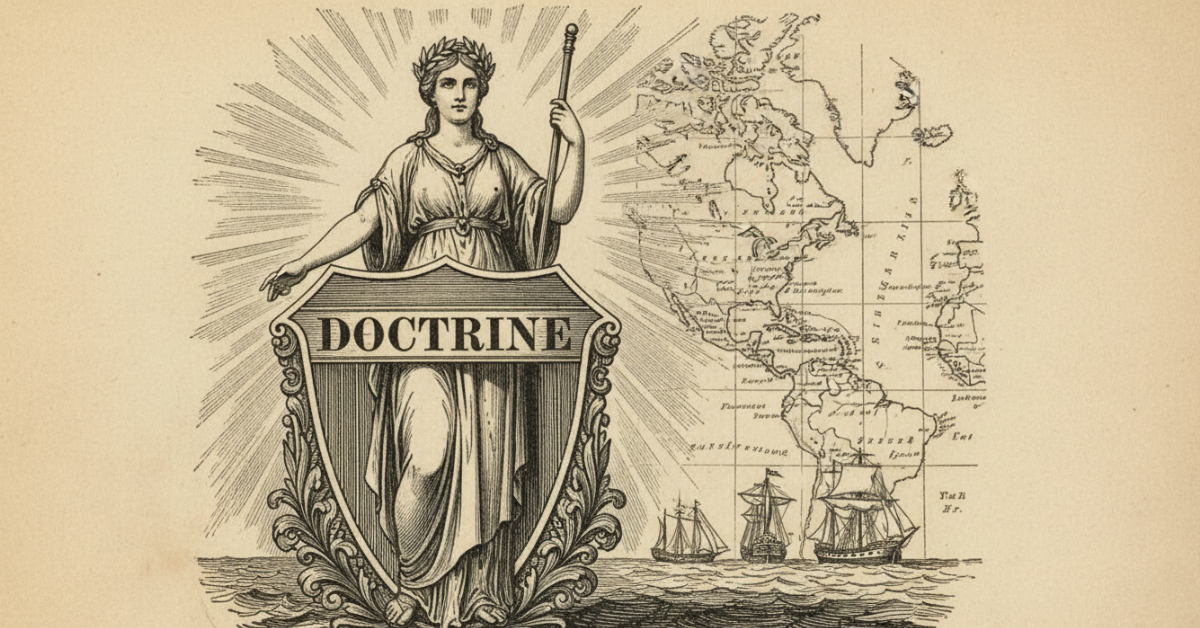
Following reports that the United States sent forces to capture Venezuela’s former leader, Nicolás Maduro, and his wife in January 2026, public interest in the Monroe Doctrine in Latin America quickly resurfaced. During a press conference at Mar-a-Lago, President Donald Trump referenced the nineteenth-century policy, and commentators began labeling his posture the “Donroe Doctrine.”
Although the Monroe Doctrine is frequently mentioned in history textbooks, its long-term impact on Latin America is often oversimplified. The Doctrine’s origins, its reinterpretation through the Roosevelt Corollary, and the regional backlash it generated shaped nearly two centuries of U.S. intervention in Latin America. Understanding that trajectory is essential for interpreting its renewed invocation today.
This article examines what the Monroe Doctrine originally meant, how it evolved into a tool of hemispheric control, how Latin America responded to it, and why Trump’s Donroe framing signals a shift back toward overt U.S. dominance in the region.
Origins of the Monroe Doctrine in Latin America (1823)
In December 1823, President James Monroe delivered an annual message to Congress that outlined a new U.S. position toward Europe and the Western Hemisphere. The Monroe Doctrine in Latin America rested on three foundational principles. First, the American continents were declared closed to future European colonization. Second, European political interference in the hemisphere would be treated as a threat to U.S. security. Third, the United States pledged to abstain from involvement in European wars and internal affairs.
At the time, however, the Doctrine functioned largely as a diplomatic warning rather than an enforceable policy. The United States lacked the naval strength to deter European powers throughout most of the nineteenth century. As a result, Spain maintained colonial control over Cuba and Puerto Rico until 1898. Likewise, France installed Archduke Maximilian as emperor of Mexico in 1864 while Washington was preoccupied with its Civil War. Although the United States protested diplomatically, it took no immediate military action. European involvement across parts of South America similarly proceeded with little direct U.S. interference (Gilderhus, 2006).
In its original form, therefore, the Monroe Doctrine was defensive. It aimed to prevent European expansion, not to justify U.S. control.
The Roosevelt Corollary and the Transformation into U.S. Hemispheric Power
By the early twentieth century, the Monroe Doctrine in Latin America had taken on an entirely new function. The turning point came after the Spanish–American War in 1898. While the United States intervened in Cuba under the banner of liberation, it subsequently occupied the island and imposed the Platt Amendment, which granted Washington the right to intervene in Cuban affairs and established long-term political influence (Tuttle, 2025).
In 1904, Theodore Roosevelt formally expanded Monroe by introducing the Roosevelt Corollary. Roosevelt argued that the United States had the authority to intervene in Latin American nations experiencing chronic instability or financial disorder in order to prevent European powers from using debt collection as a pretext for intervention (National Archives and Records Administration, 2022). This shift was reinforced by the 1902 European blockade of Venezuelan ports, which heightened fears that European creditors might reassert influence in the region (Mitchell, 1996).

The Roosevelt Corollary transformed the Monroe Doctrine into a justification for U.S. intervention in Latin America. The United States soon assumed control over customs revenues in the Dominican Republic to manage debt payments to Europe. It also carried out prolonged occupations in Cuba, Haiti, and Nicaragua. These interventions were framed as stabilization efforts; however, they expanded U.S. political and economic dominance across the Caribbean Basin.
In practice, Monroe had evolved from an anti-European shield into a tool of American power.
Latin American Reactions: From Suspicion to Resistance
For many Latin Americans, the Monroe Doctrine increasingly came to symbolize paternalism and imperial intrusion. Although U.S. officials described intervention as protective, Latin American intellectuals and policymakers argued that the Roosevelt Corollary granted Washington unchecked authority over sovereign nations (Gilderhus, 2006; Ricard, 2006).
Nicaragua offers one of the clearest examples. Between 1912 and 1933, U.S. Marines occupied the country repeatedly. Washington justified its presence as necessary to maintain order and prevent European influence. In reality, the occupation entrenched pro-American governments and subordinated Nicaragua’s political autonomy to U.S. strategic interests (Ricard, 2006; Friedman & Long, 2015).
Across the region, similar experiences reinforced the belief that the Monroe Doctrine’s implementation had replaced European empire with American hegemony. Consequently, Latin American governments began challenging U.S. interventionism through diplomacy and international law. These early resistance efforts laid the groundwork for broader hemispheric pushback.
From Soft Balancing to the Donroe Doctrine

Latin American pressure eventually forced Washington to retreat from open occupations. By the 1930s, the United States adopted the Good Neighbor Policy and publicly renounced armed intervention as a routine practice. However, U.S. influence did not disappear. Instead, it became less explicit. Economic leverage, diplomatic pressure, and institutional leadership replaced military rule (Friedman & Long, 2015).
This period marked a softer form of U.S. hemispheric dominance. Latin American nations had effectively constrained Washington through what scholars call soft balancing.
President Trump’s Donroe Doctrine signals movement away from that restraint. By openly asserting U.S. primacy in Latin America and framing Venezuela as a test case, the administration has revived rhetoric reminiscent of the Roosevelt era. When U.S. dominance becomes explicit, Latin American governments historically respond by strengthening diplomatic coalitions and legal resistance (Scarfi, 2020). Thus, the Donroe Doctrine risks reopening long-standing tensions over sovereignty and undermining regional trust.
Rather than innovation, it represents a return to overt hemispheric power.
Conclusion: The Monroe Doctrine’s Unfinished Legacy in Latin America
The Monroe Doctrine in Latin America began as a defensive warning against European colonization. Over time, it evolved into a justification for U.S. intervention and dominance, particularly through the Roosevelt Corollary. These actions provoked resistance that reshaped hemispheric diplomacy and pushed Washington toward a more restrained posture.
Today, the Donroe Doctrine revives a more explicit version of that historical framework. Latin America’s past responses suggest that renewed assertions of guardianship will not go uncontested. The Doctrine’s legacy continues to shape how power, sovereignty, and cooperation are negotiated across the Americas.
Further Reading
For readers interested in exploring how historical U.S. intervention in Latin America continues to shape regional politics and perceptions today, the following Suru Institute articles provide useful context:
- U.S. Intervention in Venezuela After Maduro — Examines the political and institutional risks that follow external involvement in regime transitions and how intervention can destabilize fragile democratic structures.
- U.S. Interventions in Latin America: Historical Lessons for Venezuela and Hemispheric Security — Connects past intervention patterns to the Venezuelan crisis and highlights how history informs regional distrust and geopolitical tension.
- Concentration Camps in Cuba and Independence Movements — Provides historical background on Cuba’s struggle for independence and illustrates how U.S. involvement emerged within broader imperial and humanitarian narratives.
References
Friedman, M. P., & Long, T. (2015). Soft balancing in the Americas: Latin American opposition to US intervention, 1898–1936. International Security, 40(1), 120-156. https://doi.org/10.1162/ISEC_a_00212
Gilderhus, M. T. (2006). The Monroe Doctrine: Meanings and implications. Presidential Studies Quarterly, 36(1), 5–16. https://doi.org/10.1111/j.1741-5705.2006.00282.x
Mitchell, N. (1996). The height of the German challenge: The Venezuela blockade, 1902–1903. Diplomatic History, 20(2), 185–210. https://doi.org/10.1111/j.1467-7709.1996.tb00622.x
National Archives and Records Administration. (2022, February 8). Theodore Roosevelt’s Corollary to the Monroe Doctrine (1904). U.S. National Archives. https://www.archives.gov/milestone-documents/roosevelt-corollary
Ricard, S. (2006). The Roosevelt Corollary. Presidential Studies Quarterly, 36(1), 17–26. https://doi.org/10.1111/j.1741-5705.2006.00283.x
Scarfi, J. P. (2020). Denaturalizing the Monroe Doctrine: The rise of Latin American legal anti-imperialism in the face of the modern US and hemispheric redefinition of the Monroe Doctrine. Leiden Journal of International Law, 33(3), 541–555. doi:10.1017/S092215652000031X
Tuttle, S. (2025, September 21). Leonard Wood in Cuba: The U.S. Military government and its lasting legacy. Suru Institute. https://suruinstitute.com/leonard-wood-in-cuba-us-military-government/