

Argentina’s Economic History During the Golden Age
At the turn of the twentieth century, Argentina stood as a global success story, marking one of the most remarkable periods in Argentina’s economic history. Its economy grew faster than almost any other nation’s, eventually rivaling Western Europe and the United States. For a brief period, Argentina even ranked among the world’s wealthiest countries per capita, and its GDP remained among the top ten for decades.
This prosperity emerged from deep global integration. Argentina exported beef, wheat, and hides to Europe and the United States. In return, it imported machinery, manufactured goods, and new technologies. This openness, combined with political independence and an abundance of natural resources, produced what many historians later called “the Argentine miracle.” This era remains central to understanding Argentina’s economic history, as the country thrived by engaging with global markets on its own terms. Although trade and investment were significant, external coercion remained relatively low during this period (Maddison, 1996).
However, a fragile dependency was bubbling beneath the surface. Argentina’s growth relied heavily on global trade, foreign investment, and European demand. When those links weakened, the entire economic model faced a whole new set of challenges.
The Boom: Export-Led Prosperity (1880s–1920s)
By the late nineteenth century, Argentina’s export economy had become the central driver of national development. The fertile Pampas, ideal for wheat and cattle, fueled rapid expansion, transforming Argentina into one of the world’s most dynamic agricultural exporters and laying the foundation for Argentina’s economic history in the early twentieth century. British investors recognized this potential and financed a vast railroad network that connected inland farms to coastal ports. As a result, agricultural goods could reach European markets quickly and cheaply. Within a decade, land values in the Pampas rose by more than 1,000 percent (Scobie, 1964).
Technological innovation strengthened the boom. Improvements in ship refrigeration made it possible to export beef to Europe and North America. The combination of fertile land, modern transport, and growing global demand transformed Argentina into one of the world’s most dynamic agricultural exporters.
This economic success also reshaped Argentina’s population. The promise of opportunity attracted millions of European immigrants, especially from Italy and Spain. Between 1890 and 1913, Argentina’s population grew from 3.3 million to 7.5 million. Almost half of this growth came from immigration (Taylor, 1994). The Avellaneda Law of 1876 encouraged this movement by creating recruitment offices in Europe, subsidizing travel, and providing temporary housing for newcomers (Hines, 1999).
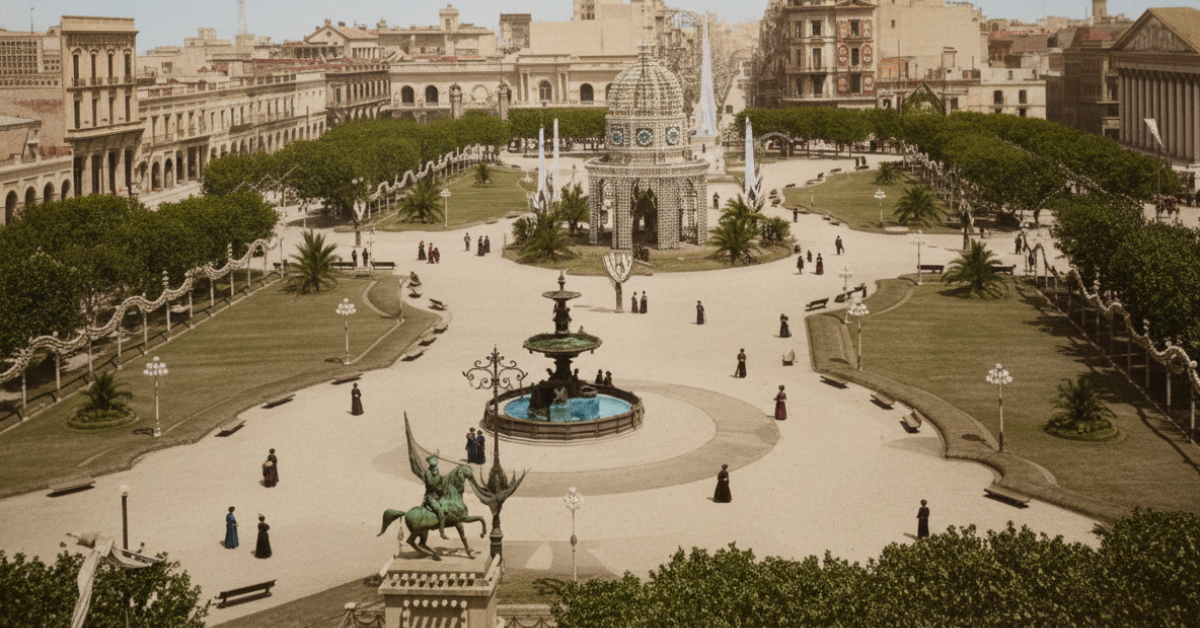
Immigrants brought labor, culture, and architecture. Their influence transformed Buenos Aires into the “Paris of South America.” Wealthy landowners, known as estancieros, built enormous fortunes, while urban elites embraced European lifestyles and fashions.
Unlike many developing nations, Argentina had been politically independent since the early nineteenth century. Its distance from major imperial powers shielded it from the colonial restrictions that shaped much of the Global South. During this period, Argentina maintained control over tariffs, monetary policy, and fiscal decisions (Maddison, 1996).
Britain, the leading global power, became Argentina’s main trading partner. Argentine grain fed British cities, while British engineers and banks financed railroads, utilities, and ports. This mutually beneficial system seemed stable. What seemed like a well-oiled machine, however, would soon face challenges as the system that sustained it started to fracture.
The First Shocks: World War I and the Fragility of Success
World War I posed the first major test of Argentina’s global integration, marking a turning point in Argentina’s economic history. At first, European demand for imports increased as factories shifted toward wartime production. This temporary surge masked deeper problems. Soon, shipping disruptions, financial turbulence, and postwar debt exposed Argentina’s dependence on external markets.
The issue was not openness itself. Instead, the problem stemmed from the fragility of a global system whose rules were increasingly shaped by political pressure rather than cooperation. As international finance became more unstable, Argentina began losing ground in its ability to act independently. These postwar contradictions continue to influence modern debates about fiscal management and development, including how Argentina uses public expenditure and macroeconomic stability to address poverty and volatility today.
The crisis intensified when Britain abandoned the gold standard in 1931. This decision destabilized global monetary systems. Credit tightened, foreign investment shrank, and agricultural exports faced steep price declines. The global liberal order that had supported Argentina’s rise now left it dangerously exposed (Taylor, 1994).
By the late 1920s, Argentina’s reliance on foreign capital and a limited range of export commodities such as beef, wheat, and wool seemed more like vulnerability than strength. Yet few foresaw how dramatically the situation would deteriorate.
The Great Depression: Crisis and Transformation
The Great Depression had a far deeper impact on Argentina than World War I, shaping Argentina’s economic history for decades to come. As global markets collapsed, Argentina’s exports plummeted. Between 1928 and 1932, export volumes fell by nearly two-thirds (Taylor, 1998). GDP dropped sharply, credit vanished, and access to foreign markets shrank. In response, the country turned inward in an effort to protect key sectors of the economy. However, this shift slowly eroded the openness that had once fueled national prosperity.
Buenos Aires, once a symbol of opportunity, became a destination for migrants fleeing rural hardship. Rapid urbanization brought unemployment, overcrowding, and new social tensions.
According to historian Roy Hora (2014), the Depression produced contrasting effects. On one hand, it widened inequality and reinforced political conservatism among elites. However, it also expanded access to education, health care, and social mobility for many urban residents. Paradoxically, the crisis accelerated modernization even as it deepened economic instability.
Factories began producing goods that had previously been imported. Urban schools multiplied. Labor movements organized more effectively. These changes laid the foundation for a profound social transformation that would later shape Peronism and also positioned Argentina within broader regional patterns of democratic expansion, crisis, and reform that continue to shape democracy in Latin America.
From Export Dependence to Import Substitution
The collapse of global markets pushed Argentina toward Import Substitution Industrialization (ISI), a shift that redefined Argentina’s economic history and national identity. Instead of relying on foreign imports, the nation promoted domestic manufacturing through tariffs, quotas, and state support (Katz & Kosacoff, 2000).
ISI was more than an economic shift. It transformed Argentine society. New industries in Buenos Aires, Rosario, and Córdoba created a growing industrial workforce. At the same time, an expanding middle class found employment in education, government, and media.
Culture also moved inward. Radio, cinema, and tango music strengthened national identity. This new social order featured smaller families, higher life expectancy, and greater urban participation (Hora, 2014). Yet problems remained. ISI deepened state control and increased dependence on imported machinery and industrial inputs. Protectionism shielded industry but also encouraged inefficiency and corruption. As a result, economic sovereignty became tied to state intervention rather than global integration. These patterns of state intervention would continue long after the ISI era, shaping debates over institutional credibility and the risks of political manipulation, as seen in cases such as government intervention in Argentina’s statistical institutes.
The Political Consequences: From Conservatism to Peronism
Economic instability reshaped national politics. In 1930, Argentina experienced its first modern military coup, ending decades of constitutional government. Military leaders and conservative elites justified their intervention as a response to chaos, but their rule reinforced inequality and restricted democratic participation.
The social insecurity of the 1930s, marked by unemployment, weakened unions, and political repression, created fertile ground for a new political movement. By the mid-1940s, Juan Domingo Perón emerged as the leader who could channel working-class discontent.
Perón’s message blended nationalism, social justice, and industrial modernization. He promised to protect workers, expand welfare programs, and strengthen national industry (Lewis, 2006). More importantly, he redefined the relationship between citizens and the state. Labor unions became political power centers, and industrial workers formed the backbone of a new populist movement.
Peronism represented both continuity and change. It extended the Depression-era expansion of the state while replacing elite conservatism with mass participation and social recognition.
Postwar Hopes and Enduring Contradictions
After World War II, some policymakers hoped to return to a more traditional economic model that emphasized open trade and stable financial systems. However, the global order had changed. Markets were volatile, and Argentina’s industrial sector had reshaped the country’s social fabric. The old model was no longer viable.
The postwar years blended nationalism with modernization. The state became central to economic planning as well as to cultural identity. At the same time, recurring inflation, political polarization, and cycles of authoritarianism destabilized the country (Wynia, 1978).
The legacy of the 1930s remained unresolved. Economic vulnerability coexisted with social progress, and disillusionment with old elites existed alongside a widespread belief in state-led development. The duality of promise and peril came to define modern Argentina.
Legacy and Reflection
By the early twentieth century, Argentina ranked among the world’s top economies, with a per-capita income comparable to that of Western Europe and, by some measures, the United States. The country later faced cycles of inflation, populism, and debt. Yet its history cannot be reduced to decline alone. The Depression and its aftermath encouraged industrialization, expanded education, and fostered a new national identity. These shifts also revealed the dangers of external dependency and the limits of unbalanced globalization, lessons still relevant across Latin America.
Argentina’s experience shows that openness does not require submission. Its golden age flourished when the nation engaged with the world freely. This period remains a pivotal chapter in Argentina’s economic history, when the nation engaged with the world freely, borrowing ideas, capital, and innovation while preserving autonomy over key decisions. The country faltered when the balance between integration and sovereignty broke down.
This lesson extends beyond Argentina. Collaboration without coercion can strengthen national resilience. When nations participate in the global order as equals—open, innovative, and self-determined—they build prosperity rather than dependency.
Argentina’s rise and turmoil thus remain both a nostalgic memory and a warning, reflecting the complexities of modernization and the ongoing struggle to maintain national autonomy in a globalized world.
Further Reading
To explore how Argentina’s long-term development patterns connect to contemporary debates on inflation, poverty, and macroeconomic stability, readers may also be interested in:
- Macroeconomic Stability and Poverty in Argentina — An examination of how fiscal imbalances, currency volatility, and institutional credibility affect poverty dynamics. The article connects Argentina’s historical vulnerabilities to present-day challenges in sustaining growth while protecting social welfare.
- Why Is Inflation So High in Argentina? — A structural analysis of Argentina’s persistent inflation, focusing on monetary instability, political incentives, and the erosion of public trust in economic institutions.
- The Néstor Kirchner Gas Pipeline and Argentina’s Energy Strategy — An assessment of how large-scale infrastructure investment shapes economic sovereignty, external balances, and long-term development strategy. The article illustrates how energy policy intersects with fiscal stability and state capacity.
References
Hines, B. (1999). An overview of Argentine immigration law. Indiana International & Comparative Law Review, 9(2), 395-421. https://doi.org/10.18060/17467
Hora, R. (2014). The impact of the Depression on Argentine society. In P. Drinot & A. Knight (Eds.), The Great Depression in Latin America (pp. 47–76). Durham, NC: Duke University Press.
Katz, J., & Kosacoff, B. (2000). Import-substituting industrialization in Argentina, 1940–80: Its achievements and shortcomings. In E. Cárdenas, J. A. Ocampo, & R. Thorp (Eds.), An economic history of twentieth-century Latin America (pp. 191–230). Palgrave Macmillan. https://doi.org/10.1057/9780230595682_10
Lewis, P. H. (2006). Authoritarian regimes in Latin America: Dictators, despots, and tyrants. Rowman & Littlefield.
Maddison, A. (1996). Unorthodox policies but rapid growth (Chap. 15).
In R. J. Salvucci (Ed.), Latin America and the world economy: Dependency and beyond (pp. 129–140). D. C. Heath.
Scobie, J. R. (1964). Revolution on the Pampas: A social history of Argentine wheat, 1860–1910. University of Texas Press.
Taylor, A. M. (1994). Three phases of Argentine economic growth. NBER Working Paper No. 5566.
Taylor, A. M. (1998). Argentina and the world capital market: Saving, investment, and international capital mobility in the twentieth century. Journal of Development Economics, 57(1), 147–184. https://doi.org/10.1016/S0304-3878(98)00081-9
Wynia, G. W. (1978). Argentina in the postwar era: Politics and economic policy making in a divided society. Albuquerque: University of New Mexico Press.