

Abstract
Venezuelan communal councils (Consejos Comunales) constitute one of the central institutions of the model of “participatory and protagonistic democracy” promoted during the Chávez era. This article analyzes their legal origins, institutional design, and practical functioning in local governance. Drawing on the legislation that regulates their creation as well as academic studies and reports from civil society organizations, the analysis examines how these community organizations interact with municipal authorities and how they have produced a hybrid institutional architecture that combines direct citizen participation with mechanisms of political centralization. The article concludes that, although communal councils expanded certain spaces for local participation, their operation reveals technical limitations, financial dependence on the national executive, and tensions with the traditional municipal system.
Keywords
Venezuelan communal councils; communal councils in Venezuela; participatory democracy; local governance; communal state; decentralization.
Venezuelan Communal Councils
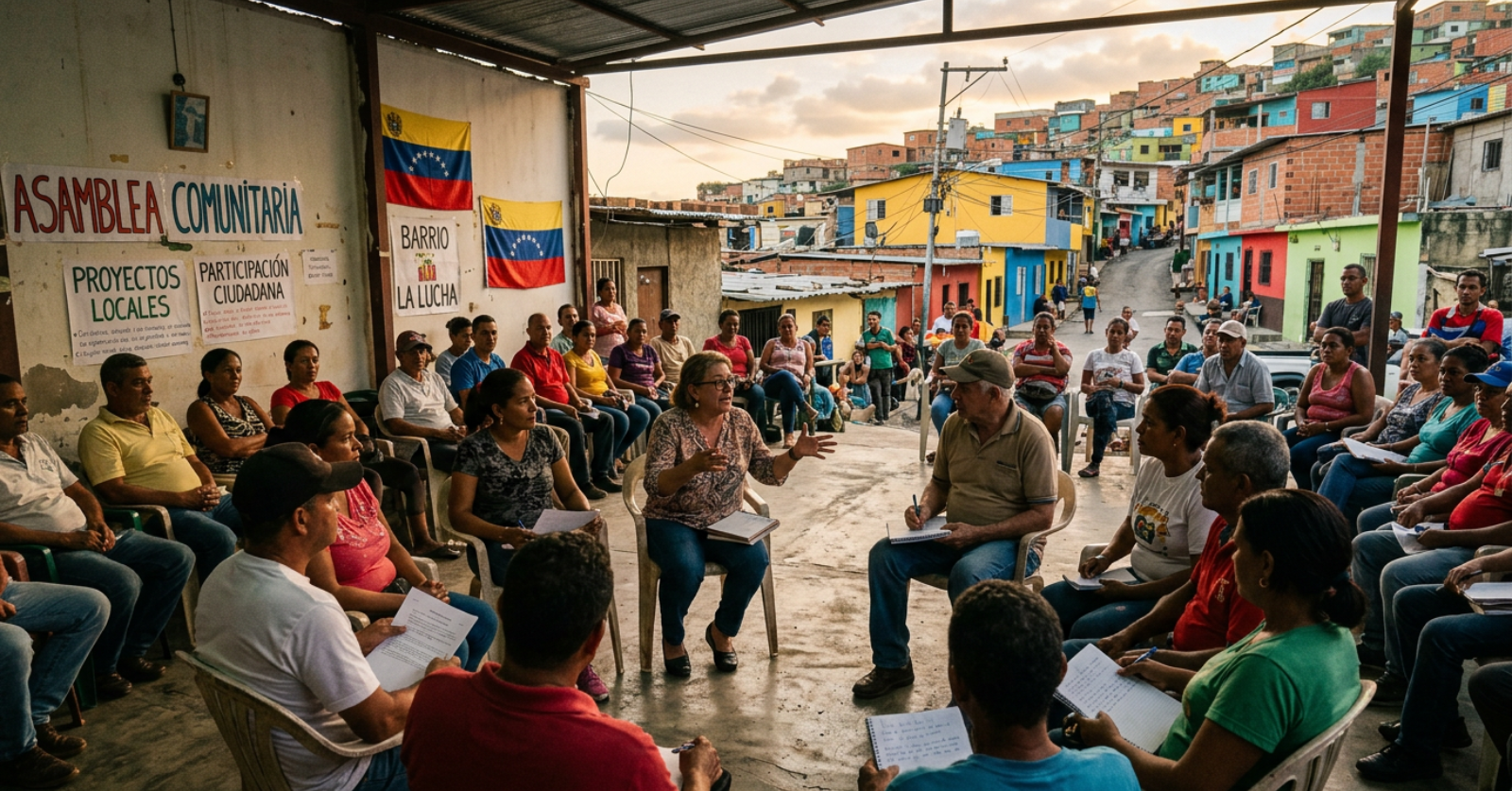
Venezuelan communal councils (Consejos Comunales) are a form of community organization created during the Chávez political project to promote direct citizen participation in local governance. With the approval of the Constitution of the Bolivarian Republic of Venezuela in 1999, the country introduced a democratic model that combined representative institutions with mechanisms of direct citizen participation.
However, these organizations were not intended merely as spaces for neighborhood coordination. The premise of “participatory and protagonistic democracy” ultimately aspired to create a broader institutional model known as the Communal State (Estado Comunal).
In theory, this design sought to transfer power directly to citizens, thereby overcoming perceived limitations of traditional representative democracy and local bureaucratic administration.
In 2006, the Law of Communal Councils was enacted, establishing territorial organizations through which citizens organized within their communities could make decisions and participate directly in local development projects and the management of public policies.
Within this context, this article examines whether communal councils truly strengthened local participation and autonomy or instead constituted a reconfiguration of territorial power through institutional structures that operate parallel to the traditional municipal system.
Legal Origins of Venezuelan Communal Councils
The concept of communal councils can be compared to other models of local participation around the world. These include participatory democracy initiatives in Kerala, India; community development committees in Tanzania and Kenya, where residents manage local health, water, and education projects under state supervision; and participatory budgeting programs in Porto Alegre, Brazil.
Nevertheless, these examples serve primarily as comparative references. The legal structure and institutional integration of communal councils are unique to the Venezuelan participatory experience.
Debates over participatory democracy have taken place globally. In Venezuela, however, the move toward citizen self-management was institutionalized through the Law of Communal Councils of 2006 (Official Gazette No. 38.083, December 30, 2006), later reformed in 2009 (Official Gazette No. 39.174, April 17, 2009) and subsequently linked to the Organic Law of Communes.
Legal Framework of the Communal System
The law establishing communal councils defines their legal nature, procedures for formation, competencies, resource management, and their relationship with municipal and state governments. It also situates communal councils within a broader political project: the Communal State.
One notable component of the system is the mechanism of social oversight (contraloría social), conceived as a form of supervision and accountability intended to ensure that citizens participate directly in overseeing community projects. In practice, however, implementation may vary depending on local conditions and resource availability. Because communal councils operate outside the formal administrative structure of municipal governments, their creation introduced a dual power configuration at the territorial level.
Unlike other participatory institutions that operate under municipal authority, communal councils are conceived as organizations with their own legal recognition. In other words, they function as forms of popular organization with direct access to national funding mechanisms.
This institutional configuration is significant because it introduces a distinctive governance arrangement. Although communal councils operate within municipal territories, they are not formally integrated into municipal or state administrative structures. Instead, they coordinate directly with national executive institutions through the ministries responsible for the communal system.
Communal Councils and Municipal Governance
The Constitution of the Bolivarian Republic of Venezuela, in Article 168, recognizes the municipality as “the primary political unit of the national organization,” endowed with legal personality and autonomy. This autonomy implies not only administrative authority but also political power derived from the direct election of local officials.
However, the central institutional tension can be understood as the coexistence of two governance models with distinct institutional logics. The architecture of the Communal State recognizes communal councils as instruments of direct decentralization, thereby creating an overlap of authority within the same territorial space.
Overlapping Competencies at the Territorial Level
From this perspective, the institutionalization of communal councils introduces a parallel governance structure operating alongside municipal authorities within the same territorial space. Their activities often intersect with traditional municipal responsibilities, including local infrastructure, community development initiatives, and the management of basic public services. In many cases, the boundaries between these responsibilities are not clearly defined in legal terms.
One of the most significant features of the system is the direct financing that communal councils may receive for the implementation of public projects without mediation by municipal governments. This arrangement creates a dual institutional dynamic: on the one hand, traditional municipal decentralization; on the other, a vertical relationship with the national executive branch.
Beyond the direct transfer of resources, this structure can also disrupt conventional urban planning processes. Communal councils may participate in projects involving large-scale service infrastructure, such as electricity distribution or water supply networks.
A further dimension of this institutional overlap concerns political legitimacy. Communal councils can function as mechanisms through which the central government maintains a strong presence in territories where locally elected municipal authorities belong to the political opposition. In this sense, the system may alter the balance of decentralization also recognized in the Venezuelan Constitution.
Rather than producing a fully decentralized model of governance, the result has been a hybrid institutional architecture in which the functional centralization of power through communal councils coexists with formal municipal autonomy. This relationship should not necessarily be interpreted solely as conflict or cooperation but rather as a structural tension embedded within the design of the institutional framework itself.
How the Communal System Functions in Practice
The functioning of communal councils depends on their integration into technical and administrative networks that they do not fully control. Although they may allocate resources and implement local projects, their autonomy is limited by the higher-level institutions that fund them.
Technical and Administrative Limitations
Another aspect to consider is technical capacity. The transfer of responsibilities related to complex services such as road infrastructure, water systems, or electricity distribution may reveal a problem of specialization. Because communal councils lack the institutional infrastructure of municipal governments—such as engineering departments or technical teams—community-level solutions may provide only short-term responses. They cannot replace the long-term planning required for large-scale infrastructure.
Participation and delegation are also important issues. The institution of the spokesperson (vocero or vocera) can shift decision-making from technical expertise toward political mediation, potentially affecting the neutrality of local governance. In communal councils, there are no mayors or council members. Instead, citizen assemblies choose representatives. As a result, the logic of political legitimacy changes. Rather than an autonomous elected authority accountable through formal institutional mechanisms, the internal dynamics of community assemblies can more easily remove the spokesperson position.
This arrangement reveals an internal structure that is both decentralized and vertically integrated: communal councils possess local capacity for project implementation, yet they remain embedded within hierarchical networks that provide funding and administrative authorization, which ultimately define the limits of their autonomy.
García-Guadilla (2008) observed that even among pro-government actors, concerns have emerged regarding the direct management of state funds by communal councils. Critics have argued that this structure may encourage clientelism and create opportunities for corruption, particularly because the oversight function known as social comptrollership is carried out by council members rather than independent supervisory bodies.
Challenges of the Communal Model in Local Governance
The Venezuelan human rights organization PROVEA acknowledges certain advantages of organized grassroots participation but also highlights several weaknesses reported by communal council participants. Among these challenges are political divisions and conflicts among neighbors, which, in some cases, have generated distrust, intolerance, and disagreements within communities and among council members (PROVEA, 2009, p. 28).
PROVEA also notes that although communal councils were initially conceived as mechanisms of direct and participatory democracy, subsequent legal, institutional, and political changes have begun to redefine their role within the Venezuelan political system.
In addition, the civil society organization Transparencia Venezuela has warned that in some areas where communal councils are more politically radicalized, residents may face pressure or intimidation linked to access to social benefits distributed through state programs. Meanwhile, a survey conducted by the Centro Gumilla Foundation found that 71 percent of respondents attributed the malfunctioning of communal councils to their spokespersons’ actions. In comparison, 16 percent considered the broader community responsible.
Conclusions on Venezuelan Communal Councils
This analysis of Venezuelan communal councils illustrates the emergence of a hybrid governance model that combines direct citizen participation with traditional local government institutions such as municipal administrations. The institutional design of communal councils reveals a novel articulation between citizen participation and the management of local development projects, while simultaneously demonstrating a strong dependence on external guidelines, resources, and implementation criteria determined outside the community.
These findings suggest that participatory democracy requires robust institutional structures capable of providing the technical expertise and administrative capacity to implement complex public projects. In this sense, citizen participation is most effective when it is integrated into professional planning frameworks rather than functioning as a substitute for them.
Further Reading
To explore broader debates about citizen participation, local governance, and institutional change in Latin America, readers may also be interested in the following articles from the Suru Institute:
- Political Decentralization in Colombia: Achievements, Limits, and the Road Ahead — An analysis of Colombia’s decentralization reforms and their impact on democratic participation and local governance. The article provides a useful comparative perspective for understanding how different institutional models seek to bring decision-making closer to citizens.
- Social Resilience in Latin America: Adaptation and Informality in Fragile Institutional Contexts — A discussion of how communities across Latin America adapt to weak institutions through informal networks and everyday resilience, offering a social perspective that complements analyses of formal governance structures.
- U.S. Intervention in Venezuela After Maduro: What Comes Next? — A reflection on the challenges of institutional reconstruction and political legitimacy in Venezuela following the potential collapse of the chavista regime.
Referencias
Asamblea Nacional. (2006). Ley de los Consejos Comunales. Gaceta Oficial no. 38.083. http://www.leyesvenezolanas.com/Leyes/ley-de-los-consejos-comunales-2006/
Asamblea Nacional. (2009). Reforma de la Ley de los Consejos Comunales. Gaceta Oficial no. 39.107. http://www.leyesvenezolanas.com/Leyes/reforma-ley-de-los-consejos-comunales-2009/
Asamblea Nacional. (2010). Ley Orgánica de las Comunas. Gaceta Oficial no. 39.300. http://www.leyesvenezolanas.com/Leyes/ley-organica-de-las-comunas-2010/
Presidencia de la República Bolivariana de Venezuela. (2007). Reglamento de la Ley de los Consejos Comunales. Gaceta Oficial no. 38.473. http://www.leyesvenezolanas.com/Reglamentos/reglamento-ley-de-los-consejos-comunales-2007/
Badell Madrid, R. (2021). Del Estado federal al Estado comunal (Serie Estudios n.º 133). Academia de Ciencias Políticas y Sociales. https://www.acienpol.org.ve/wp-content/uploads/2021/09/DEL-ESTADO-FEDERAL-AL-ESTADO-COMUNAL.pdf
Constitución de la República Bolivariana de Venezuela (1999). Asamblea Nacional Constituyente. Constitución de la República Bolivariana de Venezuela. Gaceta Oficial no. 36.860. http://www.venezuela.justia.com/federales/constitucion-de-la-republica-bolivariana-de-venezuela-1999/
Fundación Centro Gumilla. (2009). Los Consejos Comunales en Venezuela: percepciones ciudadanas sobre su funcionamiento. Fundación Centro Gumilla. https://www.gumilla.org.ve/
García-Guadilla, M. P. (2008). La praxis de los consejos comunales en Venezuela: ¿Poder popular o instancia clientelar? Revista Venezolana de Economía y Ciencias Sociales, 14(1), 125–151. Recuperado en 01 de marzo de 2026, https://ve.scielo.org/scielo.php?pid=S1315-64112008000100009&script=sci_arttext
Programa Venezolano de Educación-Acción en Derechos Humanos (PROVEA). (2009). Una mirada a los Consejos Comunales desde la perspectiva de los derechos humanos (1ª ed.). PROVEA. https://provea.org/wp-content/uploads/2021/02/consejos-comunales.pdf
Transparencia Venezuela. (2016). Los CLAP: la dominación se entrega puerta a puerta. Transparencia Venezuela. https://transparenciave.org/project/los-clap-la-dominacion-se-entrega-puerta-puerta/