

“Recovering the local economy is an act of cultural resistance.”
Néstor García Canclini, Culturas híbridas (1990)
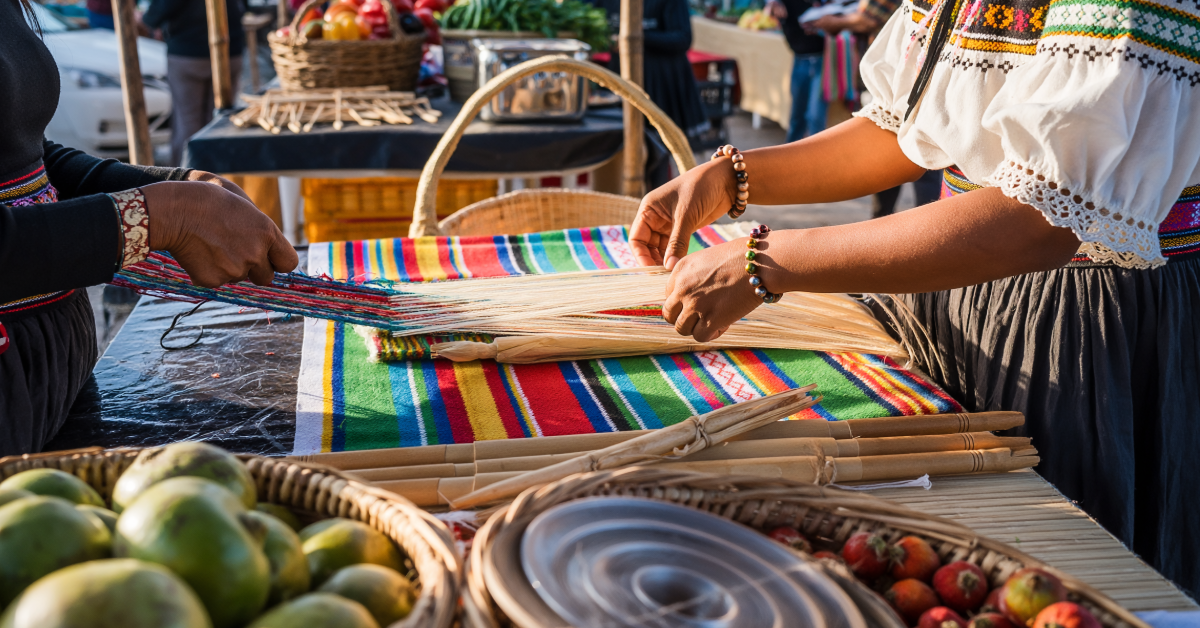
Across Latin America and the world, many communities demonstrate the economic value of ancestral culture. By reclaiming their symbols, practices, and traditions, they strengthen their identity. This also generates local economic opportunities. As we demonstrate in our analysis of the democratic crisis in Latin America, community autonomy emerges when communities regain control over their own resources and narratives. As a result, ancestral culture and the local economy intertwine. This shows that cultural preservation can fuel sustainable development. Furthermore, it demonstrates how identity and economy reinforce one another.
However, we live in a globalized world. One of its main characteristics is increasing homogenization. More and more people connect in the virtual world, where Western values dominate.
“The hegemonic pressure exerted by the West on peripheral regions is relentless; (…) the rise of information and communication technologies, the massive expansion of the internet, and the birth of social networks have accelerated these processes, mutating to levels that demand cultural homogenization and global exploitation.” (Roncal et al., 2022, p. 174).
Local values, traditions, practices, and symbols are under threat in an uneven struggle. As a result, many communities feel a diminished sense of identity and recognition within their spaces. Furthermore, this weakens their connection to shared meaning and belonging. In response, many communities are reinforcing their identities. At the same time, they are revitalizing practices that enhance cultural and economic autonomy.
The Economic Value of Ancestral Culture: Identity that Generates Development
The relationship between culture, identity, and economic development reveals that traditions are not only preserved: they also generate value and autonomy for communities. These cases show that recognizing the economic value of ancestral culture allows communities to link identity, territory, and sustainable development. Therefore, ancestral culture becomes a development strategy, not only a symbolic legacy.
Culture as a Web of Meanings
American anthropologist Clifford Geertz (2003) defines culture as a network of meanings that we create together. These meanings influence our actions in the world. This web includes the practices, meanings, and symbols we maintain in our lives. Consequently, it shapes our identities and influences others around us. The elements we use to weave this “network” can be found in our daily experiences and often go unnoticed. For instance, the way we dress, how we travel, the food we prepare, and our family relationships are shaped by our history and geography.
The way we dress, how we travel, the food we prepare, and our family relationships are shaped by our history and geography. Recognizing this helps us understand that many elements we consider insignificant are, in fact, crucial to our identity, both as individuals and as part of a community. This recognition and sense of belonging to shared values foster a connection to our roots and promote care for the land. Acknowledging our cultural heritage preserves our collective memory. Moreover, it serves as a tool for sustainable community development.
Examples of Cultural and Economic Resilience
These initiatives demonstrate the economic value of ancestral culture. Local traditions and collective organization can sustain autonomous economies. Furthermore, this model strengthens decision-making power at the community level. Tourism has proven to be an unmatched resource. For example, it promotes local values and generates economic benefits. Below are some examples:
Amador et al. (2018), in their article titled Economía social, comunalidad: orientación teórica para el turismo rural, como alternativa de desarrollo [Social Economy, Communality: A Theoretical Orientation for Rural Tourism as an Alternative for Development], suggest that rural tourism can serve as a catalyst for an economy that values practices and traditions. They propose a development model in which “forms of community organization are manifested through work, power dynamics, and cultural expressions aimed at achieving collective goals” (p. 1645). This research focuses on Mexico’s rural and indigenous communities. The model illustrates that community organization can drive economic growth independently of external structures, thereby enhancing local self-determination.
Community-Led Economic Models in Latin America
Another valuable example can be found in Ecuador with the indigenous Kichwa women and their Warmikuna NATABUELA enterprise. During the COVID-19 pandemic, they faced a crisis. They responded by following their cultural and religious traditions. This led them to reactivate essential agricultural activities (Guzmán et al., 2023). This effort resulted in more than just economic recovery. It revitalized community life and reaffirmed the role of women as guardians of cultural identity.
Similarly, we can examine the case of Mariposas Libres [Free Butterflies], a collective of organized women from the Garifuna community situated between Honduras and Belize. In addition to addressing social and gender injustices within their own communities, these women have preserved many of their community’s ancestral values and practices to develop economic projects related to agriculture and tourism (Garifuna Work to Secure Food Sovereignty in Belize, 2023). Their work shows how cultural vindication can be a strategy for economic resistance and empowerment. In other words, culture becomes economic power.
Conclusion: Culture as a Path to Autonomy
In conclusion, the elements that emerge from our continual interactions with others and with our environment significantly represent us and facilitate our communication. Recognizing this helps us grow as individuals and as autonomous communities. It also guides us toward a sustainable community economy. Ultimately, when we protect our cultural identity, we strengthen the local economy and create opportunities for ancestral culture.
Moreover, these examples demonstrate that culture is not only a heritage, but also an active force capable of transforming social realities, sustaining local economies, and fostering autonomy in the face of global homogenization processes. Therefore, when communities defend their cultural identity, they also strengthen local economies and reveal the economic value of ancestral culture in the face of global homogenization. In summary, culture operates as both heritage and economic strategy.
Further Reading
To explore how identity, exclusion, and cultural structures shape economic opportunity and community resilience across different contexts, readers may also be interested in:
- Trans Labor Discrimination in Venezuela — An analysis of how structural exclusion limits economic participation and reinforces inequality. The article examines how identity-based discrimination constrains autonomy and access to sustainable livelihoods.
- Caste Discrimination in India — A global perspective on how inherited social hierarchies shape economic opportunity. This piece highlights how cultural systems can either entrench inequality or become sites of resistance and reform.
- Entrepreneurship in Mexico: An Artisan’s Journey — A case study of grassroots economic initiative rooted in local identity and tradition. The article illustrates how individual entrepreneurship can preserve cultural heritage while generating sustainable income.
References
Amador, C. F., Villarreal, L. Z., Jiménez, G. C., & Martínez, E. E. V. (2018). Economía social, comunalidad: orientación teórica para el turismo rural, como alternativa de desarrollo. Revista Mexicana De Ciencias Agrícolas, 9, 1645–1658. https://doi.org/10.29312/remexca.v0i9.1054
García Canclini, N. (1990). Culturas híbridas: Estrategias para entrar y salir de la modernidad. México: Grijalbo. Disponible en: https://archive.org/details/culturashibridas00garc
Geertz, C. (2003). La interpretación de las culturas (A. L. Bixio, Trad.). Editorial Gedisa. https://www.gedisa.com
Guzmán, M. A., Almeida, S., Caguana, A. R., & Kowii, A. (2023). Economía comunitaria y circular, conocimiento ancestral andino: Caso Warmikuna NATABUELA. Estudios de la Gestión: Revista Internacional de Administración, 14, 127–153. https://doi.org/10.32719/25506641.2023.14.4
Malcolm-Mckay, C. (2023, February 28). Garifuna work to secure food sovereignty in Belize. Cultural Survival. https://www.culturalsurvival.org/news/garifuna-work-secure-food-sovereignty-belize
Roncal, M. F. Q., Aguirre, A. G. V., & Obando-Peralta, E. C. (2022). De la globalización hegemónica occidental a las sociedades sustentables: Desafíos para el cambio social. Zenodo. https://doi.org/10.5281/zenodo.6755173